


Your Guide to 10 Passenger Vehicles for Rent
- fantasma70
- Dec 9, 2025
- 14 min read
Trying to organize a trip for a big group can feel like herding cats. Between coordinating drivers, juggling arrival times, and finding enough parking spots, it's a recipe for a headache. This is where a 10 passenger vehicle comes in—it’s the straightforward solution that keeps everyone together and turns the journey into part of the adventure.
Why Rent a 10 Passenger Vehicle for Your Group Trip
Let's be honest, managing a convoy of cars is a logistical nightmare. You're constantly checking mirrors, texting to see if everyone made the turn, and hoping someone doesn't get lost. A single 10 passenger vehicle for rent wipes all that stress away.
It becomes your group's mobile basecamp. Suddenly, the drive isn't just about getting from A to B; it's about sharing the experience.
Simplify Your Travel Logistics
Picture this: you land, gather your group, and everyone piles into one vehicle. No waiting around for a second or third car, no frantic calls to see where everyone is. It just works.
This approach is a game-changer for:
Family Vacations: Keep the kids, grandparents, and all that luggage in one place. Simple.
Corporate Retreats: Make sure your team shows up to that important meeting or event on time and all together.
Team Outings: Heading to a game or a concert? Forget the hassle of splitting up and trying to find each other later.
Enhance the Group Experience
Some of the best memories are made on the road, but not when everyone is isolated in separate cars. When you're all in the same vehicle, the conversations, the shared playlist, and the "look at that!" moments happen naturally. The drive becomes a bonding experience, not just a commute.
For a deeper dive into these advantages, this guide to mini bus hire for group travel offers some great additional perspectives.
To put it simply, choosing a single large vehicle over several smaller ones just makes sense. It’s about more than just transport; it’s about making the entire trip smoother and more enjoyable.
Here’s a quick breakdown of how the benefits stack up.
Quick Look At 10 Passenger Vehicle Rental Benefits
Benefit Category | Advantage of a 10-Passenger Rental | Impact on Your Trip |
|---|---|---|
Logistics | Everyone travels in a single vehicle. | No more convoys, lost drivers, or staggered arrival times. |
Cost | Consolidated expenses for fuel, tolls, and parking. | Often cheaper than renting and running two or three smaller cars. |
Group Dynamics | Shared space encourages interaction and conversation. | The journey becomes a memorable, shared part of the adventure. |
Convenience | One rental agreement, one vehicle to park, one set of keys to manage. | Radically simplifies planning and reduces travel-day stress. |
As you can see, the benefits go far beyond just fitting more people in one car. It streamlines your budget, simplifies your plans, and ultimately, helps create a better group experience.
Achieve Significant Cost Savings
At first glance, the daily rate for a big van might look higher than that for a sedan. But when you do the math, it’s often the more budget-friendly option. Think about it: you're only paying for one tank of gas, one set of tolls, and one parking spot. Those savings add up fast.
Finding convenient car rental locations also helps you cut out pricey airport transfers or multiple rideshare fares. It’s a smart move in a growing market; the global car rental industry was valued at USD 129.66 billion in 2024 and is expected to hit nearly USD 300.03 billion by 2033, thanks to this growing demand for flexible group travel.
Choosing the Right Type of 10-Passenger Vehicle
When you start looking for a 10-passenger vehicle for rent, you’ll realize pretty quickly that they aren't all the same. The best ride for your crew really boils down to your group’s needs, budget, and the kind of trip you have in mind. Picking the wrong one can mean a cramped, unhappy journey, but the right van makes the entire experience smooth and fun for everyone.
Think of it like picking shoes for an outing. You wouldn't wear flip-flops to go hiking, and you wouldn’t wear hiking boots to a fancy dinner. Each type of van is built for a different purpose, and knowing the difference is the secret to a great rental.
The Reliable Workhorse: Full-Size Passenger Vans
Your classic full-size passenger van, like a Ford Transit or a Mercedes-Benz Sprinter, is the go-to for most groups. This is your no-frills, practical choice that’s perfect for getting your team from the airport, heading to a corporate event, or taking the family on a trip where just getting everyone there is the main goal. They are built to do one thing really well: move people and their stuff.
Most of these vans have bench-style seating to fit as many people as possible. They're comfortable enough for shorter trips, but the focus is definitely on function over flash. Their biggest perk is that they're easy to find and drive, making them a solid, dependable option for almost any group.
This simple breakdown shows why so many groups choose one big vehicle—it’s all about staying together, simplifying logistics, and saving money.
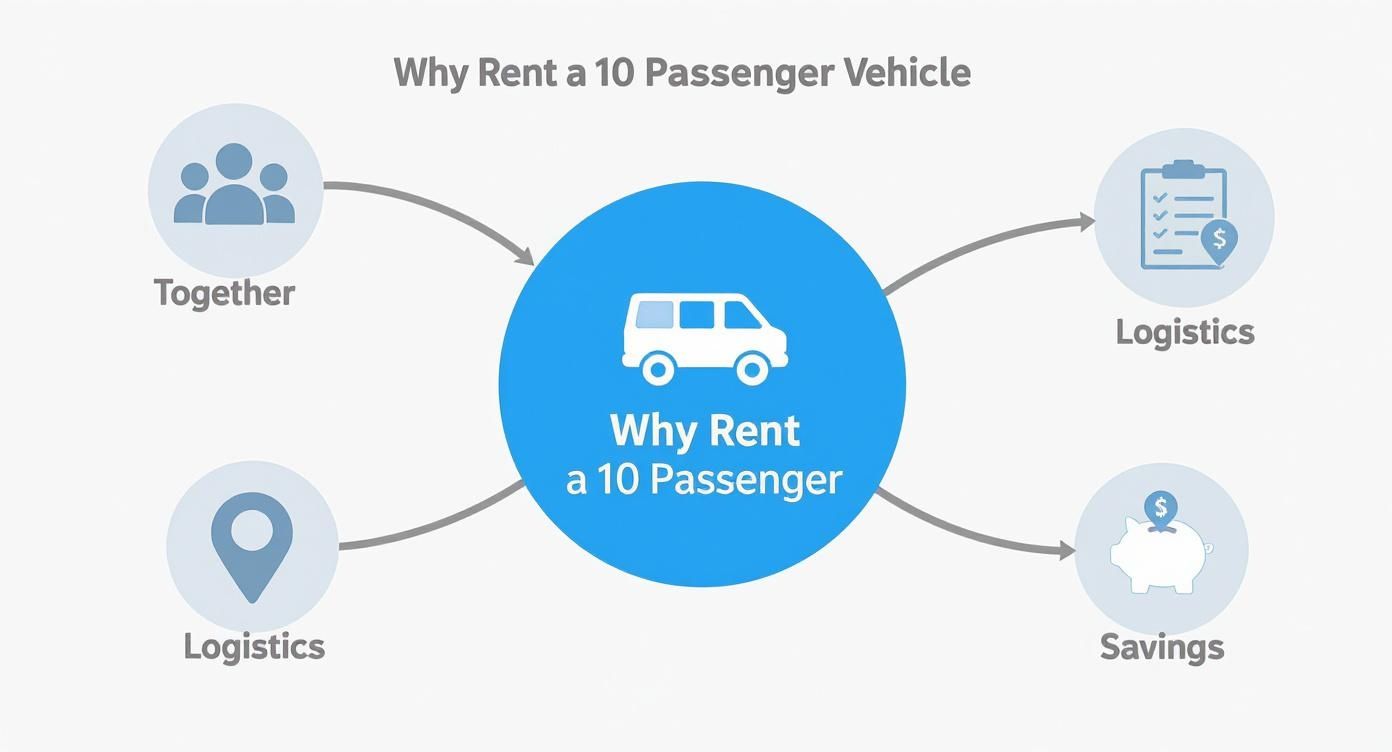
As you can see, renting a 10-passenger vehicle isn't just about transportation; it’s a smart move that makes the whole trip better for everyone involved.
The Personal Shuttle: The Minibus
If you need a bit more comfort and space, a minibus is a definite step up. While it’s still a very practical vehicle, it feels more like a private shuttle than a standard van. You'll usually find individual seats instead of benches, higher ceilings that make it easier to move around, and sometimes a separate area just for luggage.
This makes a minibus a fantastic choice for a few specific situations:
Longer Road Trips: Extra personal space and comfier seats make all the difference on a long drive.
Special Events: Perfect for transporting wedding guests or clients when you want something a little more polished.
Sightseeing Tours: The big windows and roomy interior are great for taking in the views.
Just keep in mind, its bigger size can make parking and navigating tight city streets a bit tricky, which is something to think about for a busy place like Miami.
The First-Class Lounge: Conversion Vans
For groups that want the absolute best in comfort and luxury, a conversion van is the only way to go. You can think of it as a first-class lounge on wheels. These vans are custom-outfitted with high-end features that turn a normal drive into a genuinely premium experience.
Conversion vans are less about getting from A to B and more about enjoying the journey itself. They're for travelers who value comfort and a top-tier environment over just basic transport.
Inside, you can expect things like plush leather captain's chairs, big-screen entertainment systems, cool ambient lighting, and amazing sound systems. They’re the perfect fit for executive travel, luxury tours, or any group that wants to travel in serious style. They do cost more, but for a special occasion, the incredible experience is often worth every penny.
You can browse a wide range of passenger van car types to find the one that perfectly matches your group's vibe and budget.
Matching Vehicle Capacity with People and Luggage
The number on the rental listing says "10 passengers," but that’s only half the story. The minute you start adding luggage to the mix, the real capacity changes, and this is where a lot of people get tripped up. It’s a classic mistake: assuming you can fill every single seat and bring a big suitcase for each person. This oversight can turn your pickup day into a frantic game of Tetris with bags and people, which is no way to start a trip.
Think of a 10 passenger vehicle for rent in terms of total volume, not just the number of seats. It’s a lot like packing a moving box. You can fit a bunch of small, stackable items, or you can fit just a few bulky things. Your passengers are the bulky items, and the luggage is everything else that has to find a spot.

Seating Layouts Affect Everything
The way the seats are arranged inside the van makes a huge difference in both comfort and usable space. A van with bench seating might technically have more spots, but it can feel tight and make getting to the back a real chore. On the other hand, individual captain's chairs give everyone more elbow room and make moving around inside the van much easier.
A van with four rows of seats, for example, will have almost no cargo space behind that last row. If you fill every seat, bags will end up on laps or crammed at everyone's feet. That’s not just uncomfortable; it’s a safety issue, especially on a longer drive. It's a critical detail you'll want to ask about before you book.
Calculating Your True Space Needs
Before you click that "reserve" button, do a quick and honest "luggage audit." The goal here is to avoid showing up with nine people and enough luggage for a 15-passenger van.
Here’s a simple mental checklist to run through:
Count Your Passengers: First, get the exact headcount.
Estimate Your Luggage: How many big suitcases, carry-ons, and backpacks are you dealing with? Be realistic.
Consider Your Gear: Are you bringing any bulky extras? Think golf clubs, strollers, coolers, or beach chairs. This stuff eats up space fast.
Pro Tip: If your group is close to the van's max capacity and everyone has a large suitcase, you're almost always better off renting a bigger van. Getting a 12 or 15-passenger model and keeping the back row folded down for cargo will make the ride infinitely more comfortable and safe for everyone.
Thinking ahead about luggage size can save you a massive headache. For instance, knowing how different 24 Personalized Luggage sizes will fit together is a game-changer. A van loaded with ten small carry-ons is a completely different puzzle than one packed with ten large, hard-shell suitcases. A little foresight here prevents the all-too-common problem of running out of room before you’ve even left the rental lot.
Understanding Rental Costs and Hidden Fees
The daily rate you see advertised for a 10 passenger vehicle for rent is rarely the final price you'll pay. Think of it as the starting point. To truly budget for your trip and avoid any nasty surprises at the rental counter, you need to understand what makes up the total cost.
The base rate is just for the vehicle itself. It's not a fixed number—it moves around based on when you're renting (peak season vs. off-season), the type of van you choose, and how far in advance you book. A decked-out conversion van during spring break in Miami will obviously have a higher daily rate than a standard Ford Transit booked months ahead for a quiet week in September.
Breaking Down the Total Cost
Once you get past that initial daily rate, a few other line items will show up on your final bill. The car rental business is huge—projected to hit around $60.7 billion in revenue by 2025 in the U.S. alone—and has a pretty standard set of fees. If you're not ready for them, they can be a bit confusing. You can actually read the full research about the U.S. car rental market to see how big this industry is.
Here's a look at the most common additions you'll encounter:
Taxes and Surcharges: These are unavoidable. You'll have state and local taxes, and if you rent straight from the airport, expect an airport concession fee tacked on, which can easily add another 10-15% to your total.
Insurance and Waivers: You'll be offered things like a Collision Damage Waiver (CDW) or extra liability protection. It's a good idea to check what your personal auto insurance or credit card covers beforehand, but many people opt for the rental company's coverage for peace of mind.
Additional Driver Fees: Planning on sharing the driving duties? Most rental agencies charge a daily fee for every extra driver listed on the agreement.
Fuel Charges: You have two choices: bring the van back with a full tank of gas, or let the rental company fill it up for you. Be warned, they'll charge a premium for the convenience.
To give you a clearer picture, let's walk through a sample breakdown.
Sample Cost Breakdown for a 10 Passenger Van Rental
This table gives you a rough idea of what a week-long rental might look like, helping you map out your budget more effectively.
Cost Component | Estimated Price Range | What It Covers |
|---|---|---|
Base Daily Rate | $120 - $200 / day | The cost of the vehicle itself for 24 hours. |
State/Local Taxes | 6% - 8% of total | Mandatory government taxes applied to the rental. |
Airport Concession Fees | 10% - 15% of total | A surcharge for renting from a convenient airport location. |
Collision Damage Waiver (CDW) | $25 - $40 / day | Optional waiver that covers damage to the rental vehicle. |
Supplemental Liability | $15 - $25 / day | Optional insurance for third-party injury or property damage. |
Additional Driver Fee | $10 - $15 / day | The fee to add a second or third driver to the contract. |
Keep in mind these are just estimates. The final numbers depend on the company, location, and the specific options you select.
Spotting Value and Avoiding Unnecessary Fees
While some fees are set in stone, you can find real value if you know where to look. Some companies, like Cars4Go, roll in perks that others charge extra for. Things like unlimited mileage within Florida can save you a fortune if your group is planning a road trip from Miami to Orlando and back.
The smartest renter is an informed renter. Always ask for a complete cost breakdown before you sign the rental agreement. A transparent company will have no problem explaining every charge, ensuring you know exactly what you’re paying for.
Looking for special offers is another great way to cut costs. You can often find fantastic deals on car rentals that bundle some of these extras, like a free second driver or included child seats. When those add-ons are included, your budgeting becomes much, much simpler. By getting the full picture of the costs upfront, you can pick the right van for your group without any last-minute financial stress.
Your Essential Pre-Rental Inspection Checklist
That quick five-minute walk-around you do before driving your 10-passenger vehicle for rent off the lot? It’s your single best defense against surprise charges later on. Think of it as a pre-flight check for your road trip—it’s about protecting yourself and making sure everything is good to go.
The easiest way to document everything is to pull out your smartphone. Take a quick video or a bunch of photos as you walk around the van, inside and out. This creates a timestamped record of the vehicle's exact condition when you picked it up. If any questions pop up later about a scratch or dent, you’ll have proof it was there before you ever got behind the wheel.

What to Check on the Vehicle
Before you even think about starting the engine, take a few minutes for a thorough once-over. This isn’t just about spotting dings and scratches; it’s about making sure the van is safe and ready for your whole crew.
Here’s a simple checklist to run through:
Exterior Damage: Scan the body, bumpers, and mirrors for any scratches, scuffs, or dents. Don't dismiss anything as "too small"—if you can see it, document it.
Tires and Glass: Give the tires a quick look. Do they look properly inflated? Any obvious wear? Check the windshield for any chips or cracks, as those can spread quickly.
Lights and Signals: It helps to have a friend with you for this. Test the headlights, brake lights, and turn signals to confirm they’re all working.
Interior Condition: Inside, glance over the seats. Are there any big stains or tears? Most importantly, make sure there’s a working seatbelt for every single passenger.
Key Questions for the Rental Agent
Once you've looked over the van, a few direct questions for the rental agent can clear up any gray areas. Getting on the same page now saves a ton of hassle later.
It's always smart to ask about the "what ifs." Knowing the game plan for an emergency before it happens gives you and your nine passengers some serious peace of mind.
Make sure you get answers to these essentials:
Fuel and Mileage Policies: "What’s the fuel policy? Do I bring it back full? And are there any mileage limits I need to know about?"
Emergency Procedures: "If the van breaks down, what do I do? Who do I call for roadside assistance?"
After-Hours Drop-Off: "What’s the process if I need to return the vehicle after you've closed? How will I get my final receipt?"
Navigating Driver and Insurance Requirements
When you're looking at renting a larger vehicle, like a 10-passenger van, two big questions almost always pop up: “Do I need a special license?” and “What’s the deal with insurance?”
The good news is that the answers are usually much simpler than you’d expect, which means getting on the road with peace of mind is totally doable.
Let's tackle the biggest worry first. In the United States, you do not need a special license to drive most passenger vans. A standard, valid driver's license is all you need to get behind the wheel of a vehicle that holds up to 15 people, including the driver. That means you can rent and drive a 10, 12, or even a 15-passenger van for personal trips without a Commercial Driver's License (CDL).
Understanding Your Insurance Options
While the license part is a breeze, insurance can feel a little more tangled. Generally, you have three places to look for coverage when you rent a vehicle. It's smart to understand how each one works so you can make sure you’re actually protected.
Your coverage options usually include:
The Rental Company’s Coverage: This is what they offer you at the counter, usually called a Collision Damage Waiver (CDW) or Loss Damage Waiver (LDW). It’s not technically insurance—it's more of an agreement where the rental company agrees not to come after you for repair costs if the van gets damaged.
Your Personal Car Insurance: If you have your own car, your policy might cover rental cars. But—and this is a big but—you absolutely must call your insurance agent to check. Many policies have exclusions for larger vehicles like 10-passenger vans, sometimes classifying them as "commercial-type" vehicles.
Your Credit Card: A lot of credit cards offer rental car insurance as a nice perk. The catch? The coverage is often secondary (meaning it only kicks in after your primary insurance pays) and frequently has major restrictions on vehicle types and rental lengths.
A very common mistake is just assuming your personal auto policy or credit card has you covered for a big van. Always call and verify the details for anything larger than a standard SUV before you say no to the rental company's protection.
Key Questions to Ask About Coverage
To make sure you don't have any surprise gaps in your coverage, it pays to be prepared with a few questions for both your insurance company and the rental agency. Getting straight answers before you sign anything is the best way to travel without worry.
Here’s a quick checklist to guide you:
Does my personal auto policy specifically cover a 10-passenger van rental?
Does my policy cover "loss of use" fees? (This is what the rental company charges for the income they lose while the van is in the repair shop).
If I use my own insurance, what is my deductible?
If I take the rental company's CDW, what is my maximum out-of-pocket cost if something happens to the van?
Once you have these answers, you can confidently choose the right protection for your trip and focus on the fun stuff.
Your Top Questions About Renting a 10-Passenger Van, Answered
Renting a bigger vehicle like a 10-passenger van brings up a few common questions. Let's clear the air so you can plan your trip with confidence and make sure nothing gets in the way of a great time.
Do I Need a Special License to Drive a 10-Passenger Van?
This is the number one question we get, and the answer is refreshingly simple: No.
In the United States, your standard, valid driver's license is all you need to drive a vehicle built for 15 or fewer passengers. As long as you're using it for personal travel and not for commercial purposes (like a shuttle service), no special Commercial Driver's License (CDL) is required.
Will 10 Adults and 10 Large Suitcases Actually Fit?
This is where things get tricky. While the van has seats for ten people, fitting luggage for all of them is a different story. It’s highly unlikely that ten large suitcases will fit comfortably.
The cargo space behind the last row is usually pretty limited. If everyone packs a big bag, you’ll probably run out of room fast, leaving you to cram suitcases into the aisle or onto people's laps—which is neither safe nor comfortable.
One of the most common mistakes travelers make is assuming a 10-passenger van can handle 10 people's worth of luggage. If your group is heavy on gear, it’s much safer to rent a larger 12 or 15-passenger van and simply use the back row for storage.
What’s the Fuel Economy Like on These Vans?
Let's be realistic—these are big vehicles. Fuel economy can vary depending on the specific model and your driving habits, but you can generally expect a 10 passenger vehicle for rent to get between 12 to 18 miles per gallon (MPG).
Because they’re heavier and less aerodynamic than a standard car, they are thirstier at the pump. Budgeting for fuel is a must, especially if you're planning a lot of driving. For a 300-mile round trip, you could easily use around 20 gallons of gas, so it’s smart to factor that into your travel costs.
Can I Get Child Car Seats with the Rental?
Absolutely. Most rental companies, including us, offer child safety seats for an extra daily fee. You can typically request:
Infant seats
Toddler seats
Booster seats
It is crucial to reserve them when you book your van. This guarantees they'll be ready for you on arrival. Supplies can run low, especially during busy travel times like holidays or spring break in Miami, so don't leave it to the last minute.
Ready to book the perfect van for your group's Miami adventure? At Cars4Go Rent A Car, we make it easy with door-to-door delivery, unlimited Florida miles, and no hidden fees. Book your 10-passenger vehicle today!
Comments