


Cost to Rent a Car: Your Transparent Guide to Fees and Savings
- fantasma70
- Feb 5
- 16 min read
Trying to pin down the actual cost of a rental car can feel like hitting a moving target. You see one price online, but the final bill often looks completely different. Let’s clear up the confusion.
You can generally expect a basic economy car to run anywhere from $35 per day in the slow season to well over $100 per day for a big SUV when everyone’s in town. But that's just the sticker price—think of it as the starting bid.
Your Quick Guide to Average Car Rental Costs
The price you see advertised is the base rate, but it’s not the whole story. Several other costs get tacked on before you drive off the lot, and we’ll get into those a bit later. For now, let’s just get a feel for the ballpark numbers.
What you pay really boils down to two big things: the kind of car you need and when you need it. A little economy car is great if you’re traveling light and on a budget. But if you’re hauling the whole family and beach gear, you’ll need an SUV or minivan, and that extra space comes with a higher price tag.
Seasonal Price Fluctuations
Car rental prices are all about supply and demand, just like flights and hotels. If you’re planning a trip to Miami for spring break in March, you’re going to pay a premium. That same car will cost a whole lot less if you visit in the middle of October. Knowing how these seasons work is the first step to becoming a savvy renter.
The bottom line is simple: The advertised daily rate is just the beginning. Your true cost is a mix of that base price, the car you choose, the time of year, and a handful of other fees that often catch people by surprise.
To give you a real-world idea, here’s what you might expect to pay per day for a rental in a popular spot like Miami. Remember, these are just estimates—prices can swing based on how far in advance you book, what’s available, and the specific rental company.
Estimated Daily Rental Costs in Miami by Car Type and Season
Here's a quick look at the average daily price ranges travelers can expect when renting different types of cars in Miami during high and low travel seasons. Prices are illustrative estimates.
Vehicle Type | Off-Peak Season (May-Nov) | Peak Season (Dec-Apr) |
|---|---|---|
Economy Car | $35 - $55 per day | $50 - $75 per day |
Mid-Size Sedan | $45 - $65 per day | $60 - $90 per day |
Full-Size SUV | $70 - $95 per day | $95 - $140+ per day |
Minivan | $80 - $110 per day | $115 - $160+ per day |
As you can see, just by shifting your travel dates from peak to off-peak season, you could save a bundle. You can find more details about our various pickup locations and find the one that works best for your trip. Check out our guide to car rental locations to get started.
Now that you have a solid baseline, you're ready to dig into the other pieces of the puzzle—like taxes, location fees, and insurance—that make up the real total cost of renting a car.
Breaking Down Your Rental Bill Line by Line
Ever get that sinking feeling when you see the final car rental bill? It often looks nothing like the attractive daily rate you clicked on, and it can feel like you're reading a foreign language. You're not alone. Let's pull back the curtain and translate that invoice, line by line, so you know exactly where your money is going.
Think of your rental cost like a pizza. The base rate is the plain cheese pizza you ordered. But all those other fees—the surcharges, taxes, and insurance—are the extra toppings that get added on, each with its own price. Once you understand what each "topping" is, you can start spotting the ones you don't actually need.
This flowchart gives you a good visual of how a simple daily rate can quickly balloon into a much larger total cost.
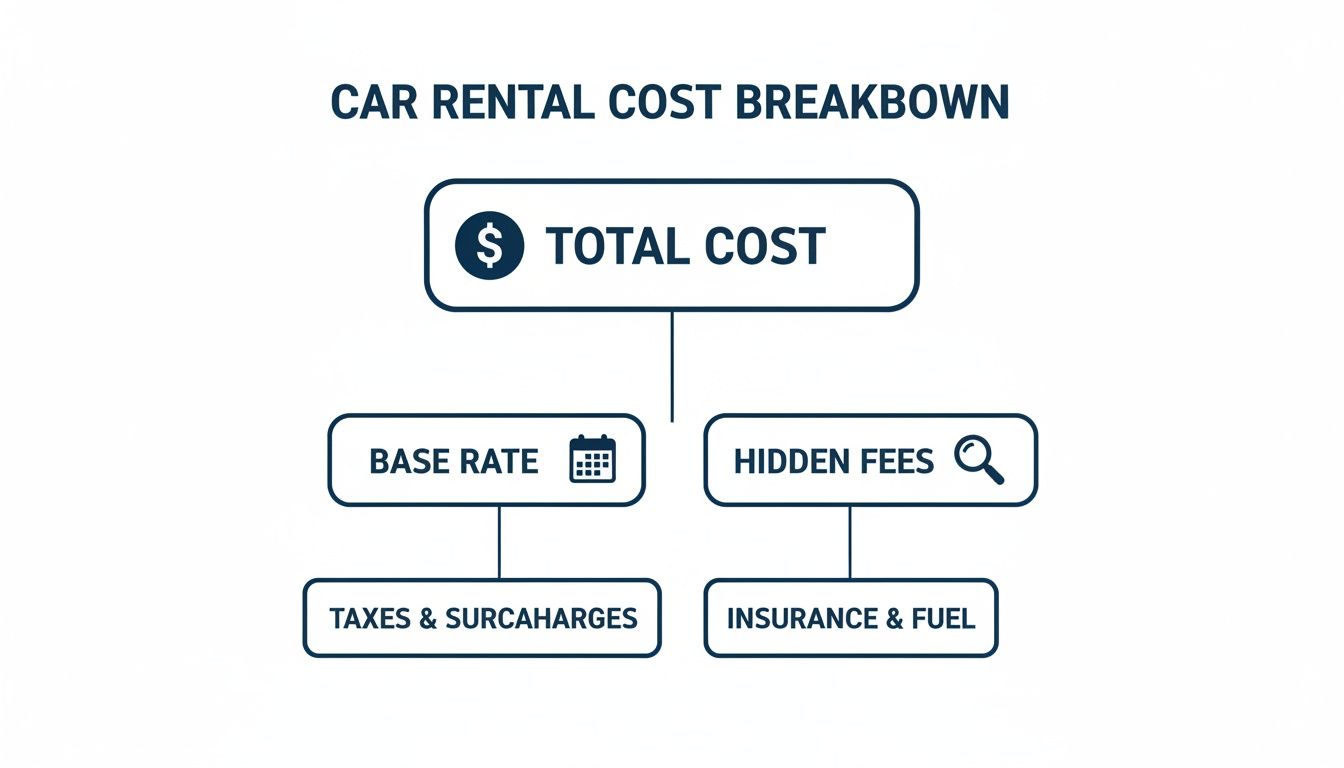
As you can see, the final price is a mix of the advertised rate and a whole bunch of other charges that can seriously inflate what you end up paying.
The Foundation: Your Base Rate
The base rate is the big, bold number you see when you first search for a car—that tempting $45 per day. This is the fundamental cost for the vehicle itself, but it's really just the starting point.
This rate changes based on the car you pick, the time of year, and how long you need it. But here’s the critical part: nearly all the other fees and taxes are calculated as a percentage of this number. So even with a low base rate, a pile-on of fees can lead to a surprisingly high bill.
Location-Specific Surcharges
Where you pick up the car matters. A lot. Rental companies have to pay a premium to operate in convenient, high-traffic spots, and they pass that cost directly on to you.
Airport Concession Fees: This is the big one. To have a desk right there when you get off the plane, rental agencies pay the airport a hefty fee. They recover that cost by adding a surcharge to your bill, often 10-15% of the total.
Customer Facility Charge (CFC): This is another airport-related fee. It’s a flat daily charge that funds things like the rental car shuttle buses and the consolidated rental center. It might only be a few dollars a day, but it adds up on a week-long trip.
This is exactly why renting from an off-airport or neighborhood location can instantly save you money. You trade a little bit of convenience for a lower bottom line.
A rental quote is an estimate, not a promise. The final cost to rent a car is only locked in once all mandatory taxes, location-based fees, and any optional extras you select are added to the base rate.
The demand for rental cars is soaring. The global market was valued at around USD 108 billion recently and is on track to hit USD 256 billion by 2030. This boom is tied to a global rise in tourism and travelers wanting more flexibility than public transport can offer. You can dig into the numbers on the global car rental market growth if you're curious.
Navigating Taxes and Government Fees
Like death, taxes are inevitable, even on a rental car. These fees are non-negotiable and are set by local, state, and federal governments. They get tacked on top of your base rate and some of the other surcharges.
You'll usually see a few of these on your invoice:
Sales Tax: The same standard state and local tax you pay on almost everything.
Vehicle Licensing Fee (VLF): A small daily fee rental companies charge to help them cover the costs of registering their massive fleets of cars.
Tourism Surcharges: Many popular tourist destinations add a special tax on things like hotel rooms and rental cars to help fund convention centers or local attractions.
While you can’t avoid them, it’s good to see them itemized so you understand how they contribute to the final tally.
Insurance and Damage Waivers Explained
This is where things can get really confusing—and expensive. The agent at the counter will almost certainly try to sell you on several different insurance products, and it pays to know what you need before you get there.
The most common one is the Collision Damage Waiver (CDW), sometimes called a Loss Damage Waiver (LDW). This isn't technically insurance. It's an agreement where the rental company "waives" its right to come after you for the cost of damages or theft. It offers peace of mind but can easily add $15 to $30 per day to your bill.
Before you say yes, do your homework. Check if your personal auto insurance policy already covers rental cars. More importantly, see what coverage the credit card you're using for the rental offers. Many premium cards include excellent rental car protection, which could save you a small fortune.
By understanding each of these line items, you go from being a confused customer to a savvy traveler who can make smart choices and keep more money in your pocket.
Uncovering the Hidden Fees That Drive Up Your Price
We’ve all been there. You find a fantastic deal on a rental car online, but when you get the final bill, the price has mysteriously ballooned. That low advertised rate is often just the starting point, before a long list of extra fees and surprise charges get tacked on.
These aren't the standard taxes or airport fees we've already covered. These are the sneaky, often aggressively sold "optional" extras that can trip up even the most experienced travelers. Let's pull back the curtain on these common budget-busters so you know exactly what to watch out for.

Fees for Drivers and Equipment
One of the easiest ways for rental costs to climb is through charges related to who is driving and what you need in the car. These fees almost always get calculated per day, so a week-long rental can turn a small line item into a major expense.
Additional Driver Fee: Thinking of sharing the driving? Most companies will charge you for the privilege. Expect a fee of $10 to $15 per day just to add another person’s name to the contract. The good news? Some companies, like Cars4Go, let you add a second driver for free.
Young Driver Surcharge: If you're under 25, brace yourself. Rental agencies see younger drivers as a higher risk, and they pass that on to you with a hefty surcharge. This fee can run anywhere from $20 to $50 per day, a real budget-killer for younger travelers.
Equipment Rentals: A GPS or a child car seat might seem like a small add-on, but the convenience comes at a steep price. Agencies often charge $10 to $15 per day for each item. On a week-long trip, you could easily spend more renting a car seat than you would buying a brand new one.
Here's a pro tip: Don't let convenience drain your wallet. A quick stop at a local Target or Walmart to buy a booster seat, or simply using the map app on your phone, can easily save you over $100 on a weekly rental.
Penalties for Fuel and Logistics
How and where you return the car can also trigger some serious penalties. The good news is that these fees are almost entirely avoidable with a bit of planning and a close read of your rental agreement.
Refueling is a classic sticking point. The rental company will present you with a few options, but only one of them is truly kind to your budget.
Prepay for a Full Tank: This sounds simple. You pay for a full tank up front and can return the car on empty. The catch? You're almost always paying an inflated price per gallon, and there's no refund for any fuel you don't use.
Let Them Refuel It: This is the nuclear option for your wallet. If you return the car with less than a full tank, the company will happily fill it for you—at a cost. They can charge up to three times the local price per gallon for this "service."
Refill It Yourself: This is always, without a doubt, your best bet. Just find a gas station near the drop-off location and top off the tank right before you return the car. It’s that simple.
Beyond fuel, the other big one to watch for is the one-way drop-off charge. If you pick up your car in Miami and need to drop it in Orlando, the company has to get that vehicle back home. They pass that logistical headache on to you in the form of a one-way fee that can easily add hundreds of dollars to your final bill.
How Transparent Pricing Makes All the Difference
The absolute best way to avoid these headaches is to rent from a company that believes in transparency. While most of the big players see amenities as another way to generate revenue, a truly customer-focused company builds them right into the price. That simple shift in mindset can dramatically lower the real cost of your rental.
To see what we mean, here's a quick look at how typical industry charges stack up against a transparent provider like Cars4Go.
Common Hidden Fees vs. Cars4Go's Included Amenities
Common Hidden Fee | Typical Industry Cost | Cars4Go's Policy |
|---|---|---|
Additional Driver | $10 - $15 per day | Included Free |
GPS Navigation | $12 - $15 per day | Included Free |
Child Car Seat | $10 - $15 per day | Included Free |
Unlimited Mileage | Often extra or limited | Included Free (in Florida) |
By knowing where these potential fees are hiding, you can stop being a passive customer and become an informed consumer. Now you're equipped to ask the right questions, politely decline the unnecessary extras, and choose a rental service that actually fits your budget.
How Your Car and Calendar Affect the Final Cost
Once you get past the jungle of fees and surcharges, two big decisions really drive the price of your rental: the car you pick and the dates you book.
Think of it like buying a concert ticket. The seat you choose (front row vs. the nosebleeds) and the popularity of the show (a Saturday night headliner vs. a Tuesday matinee) are going to massively change what you pay. It’s the exact same story with rental cars.
A bigger, fancier car will always cost more than a compact. And booking that same car over a holiday weekend? The price will definitely jump. Getting a handle on these two things is the secret to finding some serious savings.
Why Your Vehicle Choice Matters Most
The kind of car you drive sets your daily base rate, which is the starting point for your entire bill. It’s not just about size—it’s a mix of the car's sticker price, how much it costs the rental company to insure, its fuel efficiency, and simple supply and demand.
An SUV costs an agency more to buy, insure, and maintain than a little economy car, and that cost gets passed along to you. But it's also about what people are looking for. Economy cars are still the most popular choice because they're cheap to rent and sip gas, making them a huge part of the rental market.
In fact, the economy car segment is the biggest and fastest-growing in the industry, pulling in USD 53,354.2 million in revenue worldwide. It's a clear sign that travelers want budget-friendly options, especially as more people start traveling again. You can dig into more details about the global car rental market from Grand View Research.
Here’s a quick rundown of what drives the price for different types of cars:
Economy Cars: These are your cheapest option. They have a low purchase price, get great gas mileage, and there are tons of them available.
Mid-Size Sedans: A nice step up in comfort and space. They hit that sweet spot between price and features, which is why they’re a go-to for small families or business travelers.
SUVs and Minivans: These sit at the top of the price list. They're more expensive to buy and insure, use more fuel, and are always in high demand for family trips.
To get a feel for what vehicle fits your trip and budget, it’s a good idea to explore the different car types available for rent and see how they stack up.
How Timing and Trip Duration Affect Your Rate
Your calendar has just as much power over the final cost as your car choice. Rental prices are all about supply and demand, meaning when you rent and for how long can completely change the numbers on your bill.
The takeaway is simple: Flexibility is your greatest financial advantage. If you can travel during less popular times, you can often rent a much nicer car for the same price as an economy model during peak season.
Booking your rental is a bit of a strategy game. If you know the rules, you’ll always save money.
Here are the key timing factors to keep in mind:
Seasonality: A week in Miami during spring break in March is going to cost a lot more than that same week in October. High-demand times like holidays, summer vacation, and big local events always push prices up.
Booking in Advance: Waiting until the last minute will almost always cost you. Rental companies use dynamic pricing, which just means they raise rates as their cars get booked up. Locking in your rental a few weeks or even months ahead can get you a much lower price.
Rental Duration: This one might surprise you, but sometimes renting for longer can be cheaper per day. Weekly rates often have a discount baked in. If you need a car for five or six days, always check the price for a full seven—you might find it’s actually less.
Proven Strategies to Lower Your Car Rental Bill

Okay, now that you know how rental car pricing works, let’s get to the good part: how to actually lower that bill. A few smart moves can make a real difference, turning a budget-buster into a travel bargain. This isn't about finding secret loopholes; it's about using practical, field-tested strategies to keep more cash in your pocket.
Think of it like a game of chess. The rental companies have their standard moves—airport fees, insurance upsells, and peak season rates. But you have some powerful counter-moves that can help you win the savings game.
Use the Benefits You Already Have
Before you even think about paying extra at the rental counter, take a look at the resources you already have. So many travelers pay for perks they’re already entitled to, simply because they don't realize it.
The key to big savings might already be sitting in your wallet. I’m talking about insurance.
Credit Card Coverage: Many major credit cards come with rental car insurance as a built-in perk. This is often primary coverage, which is fantastic because it means you don't have to involve your personal auto insurer if something happens. Before your trip, just call the number on the back of your card to confirm the policy details.
Personal Auto Insurance: Does your own car insurance policy cover rentals? A quick call to your agent can clear this up. Knowing your coverage gives you the confidence to politely decline that expensive Collision Damage Waiver (CDW) they’ll offer you at the counter.
Book Smarter, Not Harder
The booking process itself is where you can lock in some of the biggest discounts. A few strategic clicks and a little flexibility can slash your rental bill before you’ve even packed.
It often starts with where you pick up the car. Grabbing your keys right at the airport is super convenient, but you absolutely pay a premium for it. Airport locations pass their high operating costs and concession fees straight to you, often tacking on an extra 10-15% to your bill.
Simply taking a short shuttle or rideshare to a nearby, off-airport rental location can help you sidestep those hefty surcharges. It’s an easy way to start your trip with instant savings.
Timing your booking and payment can also make a huge difference.
Prepay for a Discount: Most rental companies will give you a better rate if you pay for the whole rental upfront. It’s a great way to save, but just make sure you double-check the cancellation policy. If your plans are solid, this is an easy win.
Join Loyalty Programs: Go ahead and sign up for the rental company’s free loyalty program. Members often get exclusive discounts, skip-the-counter service, and other perks like a free additional driver.
Be Flexible with Your Dates: If your travel schedule has some wiggle room, play around with the pickup and drop-off dates. Sometimes shifting your rental by just a day or two can move you out of a high-demand window and into a much lower price bracket.
The car rental market is a huge piece of the travel industry puzzle. In fact, North America drives 40% of its global growth, fueled by both business and leisure travel. That demand is projected to push US market revenue to an estimated $60.7 billion by 2025. You can dig deeper into what’s shaping the global car rental market with Technavio's analysis.
By putting these simple strategies into play, you can book your next car with the confidence that you’ve secured the best price possible. And for travelers looking for great value from the get-go, be sure to check out our latest car rental deals for straightforward pricing and great included amenities.
Renting a Car with Confidence and No Surprises
Figuring out the real cost of a rental car can feel like trying to solve a puzzle. We've peeled back the layers, showing how that attractive daily rate is just the starting line. Now you know how airport fees can sneak up on you and how your travel dates can make or break your budget. It's time to use that knowledge to your advantage.
The whole point is to walk up to that rental counter and know exactly what to expect. No surprises, no last-minute charges. A great trip starts with a smooth rental, and that means finding a company that’s upfront about costs from the get-go.
What to Look for in a Rental Partner
The best rental experiences come from companies that treat you like a partner, not just a transaction. While some big-name agencies see every little extra as a chance to charge more, a truly customer-focused company builds those essentials right into their service. It’s a completely different and better way to rent.
Here are a few things that signal you're in good hands:
All-Inclusive Pricing: The price you see should be the price you pay. When a company includes things like a second driver or GPS in their base rate, it’s a clear sign they’re not trying to nickel-and-dime you.
Complimentary Amenities: Free child seats or unlimited local mileage aren't just perks; they show a company gets what travelers actually need.
Flexible Payment Options: Accepting both debit and credit cards without a mountain of complicated rules makes renting accessible to more people.
Choosing a rental company with clear, straightforward policies changes everything. You’re not just getting a car; you’re getting peace of mind and a predictable budget for your trip.
Armed with the insights from this guide, you now have what you need to spot genuine value. You can ask the right questions, know a good deal when you see one, and confidently avoid the common traps. This is how you make sure your next road trip starts with excitement, not sticker shock.
Got Questions? We've Got Answers
Even with all the numbers laid out, a few practical questions always pop up when you're booking a rental car. Let's walk through some of the most common worries travelers have, so you can feel totally confident when you reserve your ride.
Is It Really More Expensive to Rent at the Airport?
In a word, yes. It's tough to beat the convenience of stepping off your plane and heading straight to the rental counter, but you definitely pay a premium for it. Airports hit rental companies with hefty fees to operate on-site, like concession recovery fees and customer facility charges.
Naturally, those costs get passed right along to you. It's not uncommon for these fees to inflate your total bill by 10-15% or even more. Picking a rental spot that's just a short shuttle ride away from the airport can put some serious cash back in your pocket.
Do I Actually Need to Buy the Rental Company's Insurance?
This is the big one. The right answer really boils down to what coverage you might already have. Before you agree to that pricey Collision Damage Waiver (CDW) at the counter—which can easily tack on $15-$30 per day—it pays to do a little homework.
Here’s a pro tip: Call the number on the back of the credit card you’ll use to book the car. Many premium cards include excellent rental car insurance as a built-in perk, which means you can politely decline the expensive coverage offered at the counter.
It's also a good idea to check your personal auto insurance policy. Sometimes, that coverage extends to rental cars, too. Figuring this out beforehand keeps you from accidentally paying for the same protection twice.
What Happens If I Bring the Car Back Late?
Returning a car late can get expensive, fast. Most rental agencies give you a small grace period, usually about 29 minutes, but once that window closes, the fees start stacking up. You might get dinged for an extra hour, or more commonly, they'll just charge you for a whole extra day.
Your best bet is to always plan on being on time. If you know you're running behind, give the rental office a call right away. Sometimes they can extend your rental at the normal daily rate, which is almost always cheaper than getting hit with a late penalty.
Can I Use a Debit Card to Rent a Car?
Most of the big rental companies strongly prefer credit cards, but using a debit card is sometimes an option—it just comes with a few more hoops to jump through. You might have to deal with extra hurdles, like:
Showing proof of a round-trip flight.
Agreeing to a credit check.
Putting down a much larger security deposit (which can be held for weeks).
Having fewer vehicle types to choose from.
Finding a rental company with a clear and easy payment policy makes all the difference.
At Cars4Go, we keep things simple and clear, whether you're paying with a debit or credit card. We're all about straightforward pricing without the usual headaches. Book your next Miami trip with Cars4Go today!
Comments