


Your Florida Tourist Attractions Map For The Ultimate Road Trip
- fantasma70
- Dec 23, 2025
- 13 min read
Trying to plan a Florida road trip without a good map is like trying to navigate a theme park with your eyes closed—you'll get somewhere, but probably not where you intended. A solid Florida tourist attractions map is the single most important tool in your arsenal. It turns a jumble of must-see spots into a clear, actionable plan.
That's exactly what this guide is for. We'll help you build the perfect trip, one region at a time.
Your Essential Florida Tourist Attractions Map
Let's be honest, Florida is huge, and it draws a crowd. We're talking a staggering 143 million visitors in a single year, a number confirmed by official state reports. To avoid the stress that comes with those crowds, you need a smart plan.
Think of our map as your trip’s command center. It organizes the state’s top attractions into logical zones, making it easy to see what’s close to what. The key is to stop thinking of Florida as one massive destination and start seeing it as a collection of distinct regions, each with its own vibe. You've got the electric energy of Miami, the laid-back charm of the Gulf Coast, and everything in between.
Understanding Florida's Travel Regions
To make planning a breeze, we’ve split the state into six main tourist hubs. This approach is a game-changer because it helps you group activities together, which means less time stuck in the car and more time enjoying yourself.
Miami & The Keys: This is where you'll find vibrant international culture, stunning Art Deco architecture, and the legendary Overseas Highway that leads you to island paradise.
Orlando & Central Florida: The theme park capital of the world, plain and simple. It's home to Walt Disney World, Universal Studios, and a galaxy of other family-focused adventures.
The Gulf Coast: Famous for its calm, warm waters and postcard-perfect sunsets. This stretch includes the powdery white sands of Clearwater and the sophisticated coastal towns around Naples.
The Space Coast: A fascinating mix of raw nature and mind-blowing science, anchored by the Kennedy Space Center and miles of beautiful Atlantic shoreline.
Historic North Florida: Step back in time in America's oldest city, St. Augustine, or explore the state capital and the sugar-white beaches of the Panhandle.
To help you get a quick handle on these different areas, here’s a simple breakdown.
Florida's Regions At A Glance
Region | Primary Vibe | Top Attraction Example |
|---|---|---|
Miami & The Keys | Energetic, Cultural, Tropical | South Beach & Key West |
Orlando | Family Fun, Theme Parks | Walt Disney World |
The Gulf Coast | Relaxed, Beach-Focused | Clearwater Beach |
The Space Coast | Science & Nature | Kennedy Space Center |
North Florida | Historic, Old South Charm | St. Augustine's Old City |
This table gives you a starting point for figuring out which parts of Florida best match the vacation you're dreaming of.
Now, take a look at the map below. It gives you a bird's-eye view of these travel zones and the main highways connecting them.
Starting with a visual guide like this makes all the difference. You can immediately see how to string together a few destinations into a route that actually makes sense, creating a road trip that’s both logical and incredibly fun.
Exploring Florida By Region With Our Interactive Map
Alright, this is where the fun really begins. A simple list of destinations is a start, but seeing them laid out on an interactive map is what makes a Florida road trip click. We’ve put together a Florida tourist attractions map to be the centerpiece of your planning, color-coding everything by region to make it dead simple.
Instead of just staring at a list of names, this map lets you see the whole picture at a glance. You can literally trace your finger down the Overseas Highway to Key West, see how Orlando’s theme parks are just a stone's throw from incredible natural springs, or map out a beach-hopping adventure along the Gulf Coast. It turns planning from a headache into part of the excitement.
From South Beach To The Space Coast
The real magic of a regional map is seeing how everything connects. It helps you build a trip that actually makes sense, letting you realistically estimate drive times and pack more into each day. Let’s look at how this works for each part of the state.
Miami and The Keys: Kick things off in the buzzing Art Deco district of South Beach, then visually follow the route south. Our map lays out the islands—Key Largo, Islamorada, Marathon—like stepping stones all the way down to Key West. You can easily spot must-sees like John Pennekamp Coral Reef State Park along your path.
Orlando and Central Florida: Your eyes will immediately go to the massive cluster of theme parks. But look a little closer, and you'll spot nearby natural gems like Wekiwa Springs State Park or the lovely city of Lakeland. This makes it easy to mix those full-on park days with some much-needed relaxation in nature.
An interactive map is your secret weapon for a Florida trip. It uncovers hidden spots and shows you how to cluster your activities, saving you hours behind the wheel and giving you more time to actually enjoy your vacation.
Thinking visually like this helps you avoid the classic mistake of crisscrossing the state and wasting time. By tackling one region at a time, your journey becomes smoother and way more enjoyable.
Gulf Coast Beaches and Historic Northern Trails
As you pan west and north on the map, it keeps on delivering. You’ll see the Gulf Coast's incredible shoreline laid out before you, from the famous white sands of Clearwater down to the swanky communities of Naples and Marco Island. It’s easy to see how cities like St. Petersburg and Sarasota link up, making a multi-city beach tour a breeze to plan.
Head further north, and the map shines a light on Florida’s historic side.
St. Augustine: You can pinpoint the nation's oldest city and instantly see how close it is to other coastal spots like Daytona Beach.
The Panhandle: Just follow the coastline west to discover the sugar-white beaches of Panama City Beach and Pensacola, areas with their own unique Southern flair.
Using a tool like this just makes you a smarter traveler. For a closer look at creating your own personalized routes, check out our guide on using a Florida attractions map for reviews and planning. It’s packed with more advanced tips for crafting your perfect itinerary. This way, you’ll spend less time figuring things out and more time soaking up everything the Sunshine State has to offer.
How To Plan Your Perfect Florida Road Trip Itinerary
Alright, now that you have a feel for Florida's distinct regions, it's time for the fun part: connecting the dots and building your dream road trip. A good Florida tourist attractions map is your best tool here, helping you create a route that flows naturally from one incredible stop to the next.
Let's dive into three popular week-long itineraries, all starting from our home base in Miami.
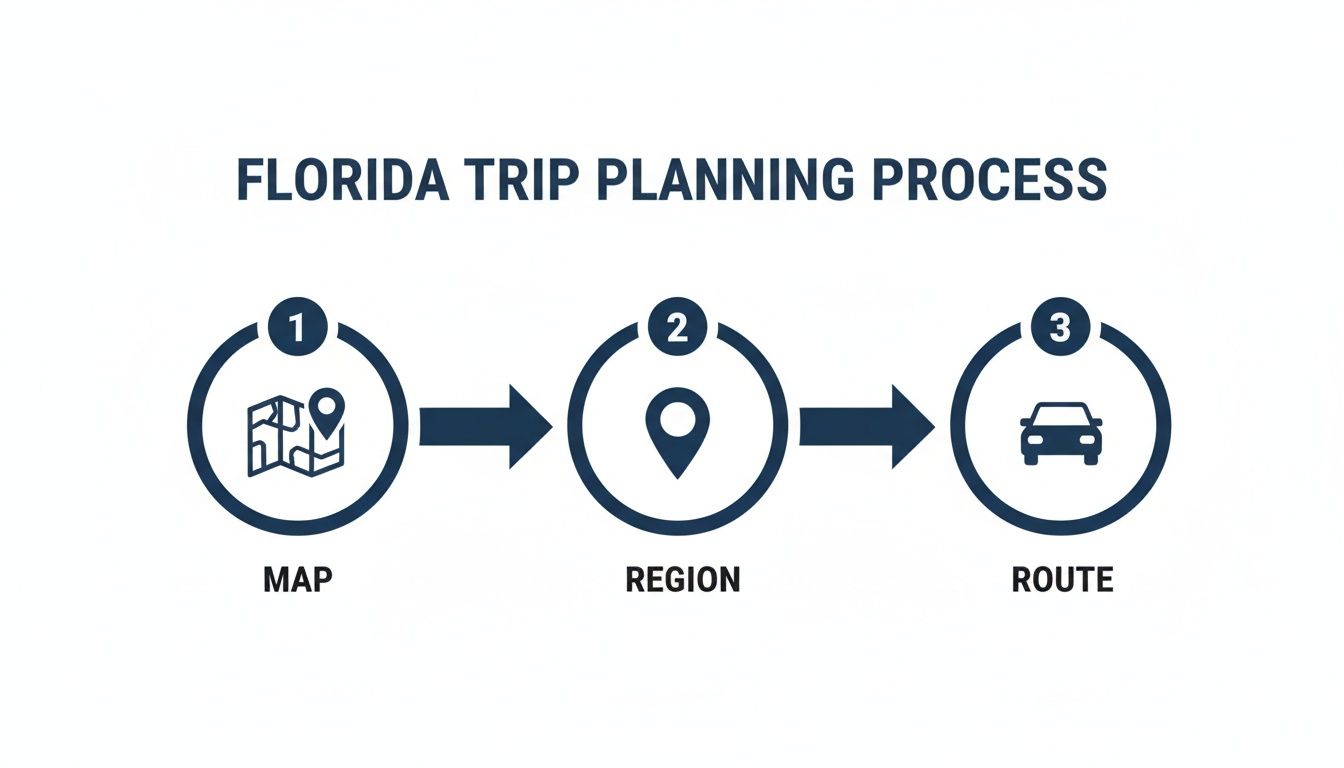
This simple guide breaks down the planning process. First, you use the map, then pick your regions, and finally, build your route. It’s a straightforward way to make sure you spend less time driving and more time enjoying yourself.
Let's see how this works in practice with a few road-tested travel plans.
Itinerary 1: The Classic Coast-to-Coast
This trip is the ultimate Florida sampler. You get a taste of everything: the electric energy of the city, the non-stop fun of the theme parks, and the laid-back vibe of the beach. It’s perfect for first-timers.
Days 1-2 in Miami: Kick things off by soaking up the iconic culture of South Beach and the historic charm of Little Havana.
Days 3-5 in Orlando: Head north on a roughly 4-hour drive to the theme park capital of the world. Get lost in the magic of Walt Disney World or feel the thrills at Universal Studios.
Days 6-7 in Tampa/Clearwater: Drive west for about 90 minutes to reach the gorgeous Gulf Coast. Unwind on the powdery white sands of Clearwater Beach before you fly home from Tampa.
A great road trip tells a story. Every stop should feel like the next chapter, creating a journey that’s both seamless and unforgettable.
This route gives you a fantastic look at the diverse landscapes of South and Central Florida. And don't forget, the right car makes all the difference. It's smart to explore the https://www.cars4go.com/car-types.php to find the perfect fit—whether you need a roomy SUV for the family or a breezy convertible for cruising the coast.
Itinerary 2: The Scenic South
If tropical views and incredible nature are what you're after, this is the itinerary for you. This journey takes you deep into the state’s most stunning southern landscapes, full of turquoise water and one-of-a-kind wilderness.
Days 1-3 in The Florida Keys: From Miami, point your car south and hit the legendary Overseas Highway. Make a day of the drive itself, stopping in Key Largo and Islamorada on your way to Key West.
Days 4-5 in Everglades National Park: Turn back north and steer into the "River of Grass." An airboat tour is a must-do for spotting alligators and getting a feel for this unique ecosystem.
Days 6-7 back in Miami: Circle back to the city to catch anything you missed, from the vibrant street art at the Wynwood Walls to the stunning Vizcaya Museum and Gardens.
Itinerary 3: The History and Space Route
This northbound trip is a dream for history buffs and science geeks. You’ll travel up the Atlantic coast, exploring America's colonial roots and the frontier of space exploration.
For those planning a longer-term adventure on wheels, these handy full-time RV living tips can be a great resource for getting organized.
Days 1-2 in Miami: Get your trip started with the high-energy vibe of South Florida.
Days 3-4 on The Space Coast: Drive about 3.5 hours north to the area around Cape Canaveral. You'll want a full day to explore the amazing Kennedy Space Center.
Days 5-7 in St. Augustine: Continue north for another 2 hours until you reach America's oldest city. Get lost on the historic cobblestone streets, visit the Castillo de San Marcos, and soak in the old-world charm before you head back.
Essential Driving and Rental Car Tips in Florida
A Florida road trip is one of the best ways to see the state, but it definitely helps to know the lay of the land before you get behind the wheel. You won't be alone out there—a staggering 62.3% of domestic visitors drive to and around Florida, so a little prep work can make all the difference. Think of this as your insider's guide to a smooth ride.

Let's talk tolls. Most major highways, especially around Miami and Orlando, are covered in them. To avoid getting hit with unexpected fees, you’ll want to know your options:
SunPass: This is a prepaid transponder you can buy. It's usually the most budget-friendly way to pay tolls.
Toll-by-Plate: This is the default for most rental cars. A camera snaps your license plate, and the rental company gets the bill. They'll pass the cost on to you, plus a service fee.
Picking the right rental car is just as important as planning your route. A convertible is practically mandatory for a drive through the Keys, but an SUV is a lifesaver for a family hauling luggage to the theme parks.
Choosing Your Ideal Rental Car
The car you choose can make or break your trip's comfort and budget. If you're planning long hauls between cities, a fuel-efficient sedan will save you a nice chunk of change on gas. For families, the extra room in an SUV or minivan for people and all their stuff is non-negotiable.
Ready to book? We have convenient Cars4Go rental locations at all the major airports and tourist spots to get you on your way quickly.
Navigating Traffic and Parking
Like any popular place, Florida’s big cities get choked with traffic during rush hour. Try to avoid driving between 7-9 AM and 4-6 PM on weekdays if you can. A good navigation app is your best friend for finding alternate routes.
And if you're using your phone to navigate, it’s a good idea to know how much data Google Maps uses to avoid any surprises on your next bill.
Parking can be a headache in the busiest spots. When you're heading to the theme parks, get there early. You'll snag a closer spot and might avoid paying extra for premium parking. For beaches like South Beach or Clearwater, hunt for public garages—they're almost always cheaper than metered street spots. Many cities now have apps that let you pay for and extend your parking time right from your phone, so you don't have to sprint back to feed the meter.
Seasonal Planning And Insider Travel Tips
Deciding when to visit Florida is just as crucial as figuring out what you want to see. The entire vibe of the state shifts with the seasons, affecting everything from how crowded the beaches are to how comfortable you'll feel walking around. Getting the timing right is the secret to a road trip you'll remember for all the right reasons.
You can really break down Florida's travel calendar into three distinct periods. First, you have peak season, which generally runs from December through April when northerners escape the cold. Then comes the hot, sticky summer season from June to August. Sandwiched between them are the shoulder seasons in spring (May) and fall (September to November)—and honestly, this is the sweet spot for many savvy travelers.
Navigating Peak Season And Shoulder Seasons
There’s no denying that winter in Florida is gorgeous. We're talking sunny days with temperatures in the mid-70s. But that perfection comes with a price tag. Expect to pay more for hotels and your rental car, and get ready to share attractions with plenty of other people. If you're traveling during this time, booking well in advance isn't just a good idea; it's essential.
On the flip side, the shoulder seasons of spring and fall strike a perfect balance. The weather is still fantastic—warm and sunny—but the big crowds have gone home. That translates to more room to spread out on the sand, shorter queues for rides at the theme parks, and better prices on places to stay. I always tell people that May, October, and November are some of the best months for a road trip here.
Smart timing can completely change your Florida experience. Visiting during a shoulder season often means you get peak-season weather without the peak-season crowds, giving you the best of both worlds.
Mastering The Summer And Hurricane Season
Summer in Florida means three things: heat, humidity, and daily afternoon thunderstorms. From June through August, the thermometer will creep into the 90s almost every day. If you’re visiting then, you have to learn to beat the heat by planning your big outdoor adventures for the morning or late afternoon. Trust me, water parks, natural springs, and the beach will become your best friends.
You also can't talk about summer and fall without mentioning hurricane season, which officially runs from June 1st to November 30th. The most active period is usually from mid-August to mid-October, but a storm can pop up anytime. That doesn't mean you should cancel your plans, but it absolutely means you need to be smart about it.
Here are a few tips to keep your trip smooth:
Book Flexibly: Look for hotels and flights that offer refundable options, just in case.
Stay Informed: Start keeping an eye on the weather forecast as your travel dates get closer.
Pack Smart: No matter when you come, you’ll need reef-safe sunscreen, a good bug spray (especially for the Everglades), and a light rain jacket for those sudden downpours.
One final insider tip that applies year-round: book your theme park tickets and any popular tours months ahead of time. And for the beaches? Get there early—before 10 AM is a good rule—to snag a decent parking spot and claim your slice of paradise before it gets packed. A little planning goes a long, long way in the Sunshine State.
Answering Your Top Florida Road Trip Questions
Even with a great map in hand, you're bound to have a few questions as you start piecing together your Florida adventure. That's completely normal. To help you iron out those final details, I've rounded up the most common questions travelers ask.
Think of this as your pre-trip checklist. A little bit of insider knowledge goes a long way in making sure your drive is as smooth as the sand on Siesta Key beach.
When’s The Best Time of Year To Actually Go?
Honestly, the sweet spot for a Florida road trip is spring (March to May) or fall (September to November). These are what we call the "shoulder seasons."
During these months, the weather is fantastic, the summer and winter crowds have thinned out, and you can usually find better prices on everything from your rental car to your hotel room. Spring is gorgeous with everything in bloom, while fall offers a welcome break from the summer humidity. Just be aware that September is still technically hurricane season, so trip insurance isn't a bad idea.
How Many Days Do I Really Need to See Florida?
To get a real taste of Florida without spending the whole time in your car, you'll want at least 7 to 10 days. That gives you enough time to properly explore two or maybe three different parts of the state.
For example, you could hit the Orlando theme parks for a few days, relax on the Gulf Coast beaches for a couple more, and then head down to experience the energy of Miami. If you're dreaming of driving all the way down to Key West or exploring the historic streets of St. Augustine, you’ll be much happier adding a few extra days and giving yourself 10 to 14 days total.
The number one mistake people make is underestimating the driving. Florida is huge! It’s far better to soak up a few places than to just race from one spot to the next, checking things off a list.
What’s The Deal With All The Toll Roads?
Yes, toll roads are everywhere here, especially around Orlando, Miami, and Tampa. The simplest way to handle them, by far, is to use the toll pass program your rental car company offers. It’s a total lifesaver, letting you zip through the electronic lanes without fumbling for cash.
Most tolls now use a "Toll-by-Plate" system anyway. A camera snaps a picture of your license plate, and the bill goes straight to the rental company. They’ll then charge the card you have on file, usually with a small service fee. Finding a tollbooth that still takes cash is getting rare, so an electronic pass is really the only stress-free way to go.
Which Airport Should I Fly Into?
This one is simple: the best airport is the one closest to where your road trip begins. Picking the right one can easily save you half a day of driving.
Hitting the Theme Parks? Fly into Orlando International Airport (MCO). It's the gateway to Disney, Universal, and all things Central Florida.
Exploring South Florida? For Miami, the Everglades, or the Keys, your best bets are Miami International (MIA) or Fort Lauderdale-Hollywood (FLL).
Chasing Sunsets on the Gulf Coast? To see St. Pete, Sarasota, or Naples, fly into Tampa International (TPA). It puts you right in the middle of the action.
My best advice? Use your Florida tourist attractions map to figure out your route before you book your flight. Once you know where you’re starting, picking the right airport is a no-brainer.
Ready to hit the road and explore everything on your map? At Cars4Go Rent A Car, we make it easy with convenient airport pickups, a wide selection of vehicles, and no hidden fees. Book your perfect Florida road trip car today!
Comments