


what is liability insurance for rental cars? A Simple Guide
- fantasma70
- Dec 1, 2025
- 14 min read
Picture this: you're navigating the streets of Miami in your rental car, you get distracted for a split second, and boom—you cause a fender bender. Liability insurance is what stands between you and a massive bill for the other driver's expenses.
It’s not for fixing your rental car or covering your own doctor visits. Instead, it pays for the damage to their car, their property, and their medical bills.
Understanding Your Financial Shield on the Road
When you're at the rental counter, you'll likely be offered a menu of insurance options. Of all of them, liability coverage is arguably the most critical. It’s not about protecting the car you’re renting—it’s about protecting your savings and assets from the fallout of an accident you cause.
Think of it as a financial buffer between your bank account and the other driver's repair shop or hospital.
If you don't have it, you're on the hook for every single dollar of damage you inflict on others. That includes not just the obvious car repairs but also potential legal fees if things escalate to a lawsuit.
What Liability Insurance Actually Covers
To really understand liability insurance, you need to be clear on what it pays for and, just as importantly, what it doesn't. This coverage is strictly for third-party damages—that is, costs incurred by people other than you.
It's designed to handle two main things:
Property Damage: This pays to fix or replace the other person's car. It also covers any other property you might have damaged, like a mailbox, a fence, or a storefront.
Bodily Injury: This is the big one. It covers medical expenses, lost wages from time off work, and even pain and suffering for anyone injured in the other vehicle.
Liability insurance is all about your legal and financial responsibility to others. It’s designed to handle the financial consequences when you're at fault, ensuring the other party is made whole without you having to liquidate your savings.
To keep things crystal clear, here’s a quick breakdown of what liability insurance for a rental car typically covers and what it leaves out.
Liability Insurance What It Covers vs What It Does Not
Coverage Area | Is It Typically Covered by Liability? | Brief Explanation |
|---|---|---|
Damage to the other person's car | Yes | It pays for repairs or replacement if you're at fault in an accident. |
Medical bills for the other driver | Yes | This covers hospital stays, doctor visits, and related medical costs. |
Damage to your rental car | No | You need a Collision Damage Waiver (CDW/LDW) for this. |
Your own medical bills | No | This would be covered by your personal health insurance or PIP coverage. |
Damage to public/private property | Yes | If you hit a fence, a sign, or a building, liability helps pay for it. |
Legal fees if you get sued | Yes | It often covers your legal defense costs related to the accident. |
Theft of the rental car | No | This is usually covered by a Loss Damage Waiver (LDW). |
As you can see, the lines are pretty distinct. It's crucial to remember that this insurance will not pay for damage to the car you're driving or your own injuries. For that, you’d need separate coverages like a Collision Damage Waiver (CDW) or your own health insurance. Getting this distinction right is the first step to making a smart, confident decision at the rental desk.
Why Liability Coverage Is Not Just an Upsell
Standing at the rental counter, it's easy to dismiss any extra insurance as just another fee. It feels like a last-minute upsell designed to squeeze a few more dollars out of you. But when it comes to liability coverage, thinking that way is a dangerous mistake. Declining it isn't saving money—it's taking on a massive financial gamble.
Without the right liability protection, you are personally on the hook for every single dollar of damage you cause if you're at fault in an accident. We're not just talking about a dented bumper here. This covers the other driver's medical bills, their lost wages while they recover, and the cost to repair or replace their property. These costs can spiral into the tens, or even hundreds, of thousands of dollars in the blink of an eye.
Picture this: you make one small mistake in hectic Miami traffic, and it causes a multi-car pileup. The resulting claims could easily bankrupt someone who is uninsured or doesn't have enough coverage. This is why understanding what is liability insurance for rental cars is less about the rental transaction and more about protecting your entire financial future.
The Soaring Cost of Accidents
Today's cars are packed with sensors, cameras, and complex electronics, making them more expensive to fix than ever before. A simple fender-bender that might have cost a few hundred dollars to repair a decade ago can now easily run up a five-figure bill. The minimum liability coverage required by the state often doesn't even come close to covering these inflated costs, leaving you to pay the enormous difference out of your own pocket.
This financial risk is only getting bigger. Recent data shows a clear trend: both the number and the cost of liability claims involving rental cars are on the rise. This spike is fueled by higher repair bills, more people renting cars, and increasingly congested traffic in tourist hotspots. You can read more about this in an in-depth analysis of rental car insurance claims. For renters, this means the chance of facing a huge claim is higher than ever, making good liability protection an absolute must.
Think of it this way: State minimum liability is like bringing a bucket to a house fire. It might handle a tiny flame, but it’s completely inadequate for a real disaster. Supplemental liability coverage is your fire hose.
At the end of the day, supplemental liability insurance isn't a frivolous add-on; it's an essential shield. It gives you the peace of mind to actually enjoy your trip without the nagging fear of a financially devastating accident. That small daily fee is a tiny price to pay for protection against a potentially life-altering expense.
Where to Find Your Rental Car Liability Coverage
Before you even think about buying extra insurance at the rental counter, take a deep breath. You might already be covered and not even know it. Your financial shield for a rental car could be tucked away in your wallet or waiting in your existing auto insurance policy.
Figuring out where to look can save you a surprising amount of money and a lot of stress. Essentially, you have three main avenues for liability coverage: your personal car insurance, the rental company’s own supplemental plan, or in some rare cases, a travel insurance policy. Let’s break down what each one really means for you.
Your Personal Auto Insurance Policy
If you own a car, the very first place you should look is your current auto insurance policy. For most drivers, the liability coverage you carry for your own car follows you when you rent another one for personal use. This means the same protection you have for bodily injury and property damage at home comes along for the ride on your trip.
But—and this is a big but—you can't just assume this is the case. Before you go anywhere, a quick call to your insurance agent is a must.
Here’s exactly what you need to ask:
Does my liability coverage extend to rental cars in Florida (or wherever you're headed)?
Are there any catches? For example, does it cover me if I'm traveling for work or renting a large van?
Are my coverage limits high enough for peace of mind?
Relying on your own policy is usually the cheapest route, but only if the coverage is solid enough for your trip.
This flowchart shows what happens financially after an at-fault accident. It's a simple visual, but it powerfully illustrates how liability insurance acts as a buffer between a crash and your bank account.
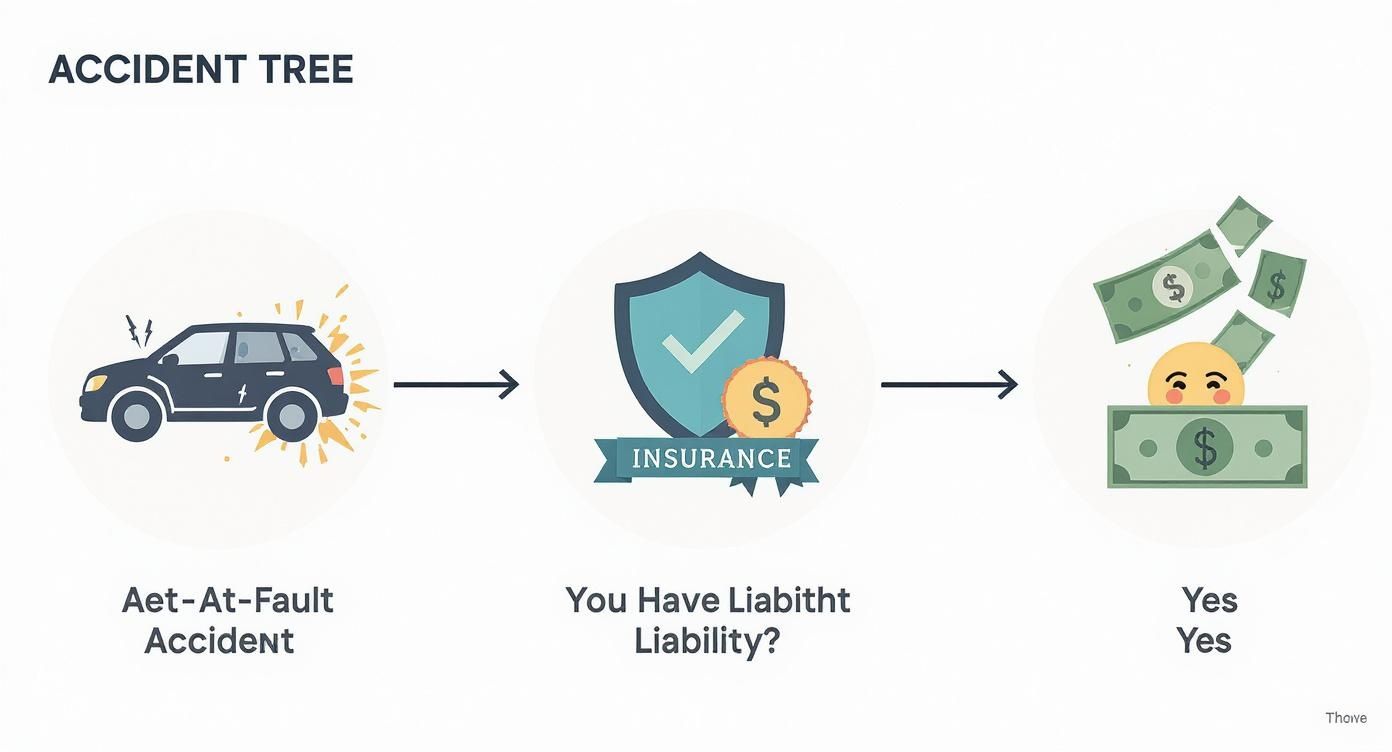
As you can see, having that insurance shield is what stops a bad day from turning into a devastating financial event.
Supplemental and Credit Card Options
What if your personal policy doesn’t cover rentals, or the limits just feel too low? Your next move is to consider Supplemental Liability Insurance (SLI) right from the rental company, like Cars4Go. It’s designed to give you high-limit protection, often up to $1 million, and it becomes your primary line of defense if you cause an accident. It's a simple, albeit more expensive, way to know you're protected.
Now, let’s clear up a huge point of confusion: credit cards. While many premium credit cards boast great rental car benefits, they almost always cover collision damage to the rental car itself (the CDW/LDW). They typically do not cover your liability for damage you cause to other people or their property.
It's a common mistake to think your credit card insurance benefits are an all-in-one solution. For liability, they rarely are. The global rental market, especially in North America and Europe, is built around regulations that require liability coverage. In fact, European rules alone influenced about 30% of the global market in 2023, which shows just how non-negotiable this protection is. Always double-check your sources before you drive off the lot.
Comparing Your Liability Coverage Options
Deciding between these options can feel overwhelming, so here’s a quick comparison to help you weigh the pros and cons of each source.
Coverage Source | Typical Coverage Level | Pros | Cons |
|---|---|---|---|
Personal Auto Policy | Same as your regular policy (e.g., $100k/$300k/$50k) | No extra cost; familiar coverage. | May not extend to all rentals; limits might be too low. |
Rental Company's SLI | High limits, often up to $1 million. | Convenient; very high protection; acts as primary coverage. | Can be expensive (adds a daily fee); may be unnecessary if you're already covered. |
Credit Card | Usually $0 for liability. | Excellent for collision damage to the rental car. | Almost never provides liability coverage for others' damages. |
Ultimately, the right choice depends on your personal insurance, your risk tolerance, and your budget. Take a few minutes to make the calls and check your policies—it’s the smartest move you can make before starting your trip.
Primary vs. Secondary Coverage Explained
Navigating rental car insurance can feel like you're trying to read a foreign language, but one of the most important concepts to get right is primary vs. secondary coverage. The easiest way to think about it is like a starting lineup for a sports team.
Your primary coverage is your starting player. It’s the first one on the field to tackle the problem. Your secondary coverage is the backup, waiting on the bench to jump in only after the starter has given it their all and can't do any more.
In the world of insurance, this difference is a very big deal. A primary policy is the first to pay out on a claim, handling the costs directly without you having to involve any other insurance you might hold. That's a huge benefit.
A secondary policy, on the other hand, does exactly what its name implies—it comes second. It will only start paying for damages after your own personal car insurance has paid out everything it can, right up to your policy's limit. This can make the claims process more complicated and can have a real impact on your personal policy.
Why Does This Distinction Matter So Much?
So, why should you care if your coverage is primary or secondary? It all boils down to protecting your own auto insurance policy.
If you cause an accident in a rental car and your personal auto insurance is your primary source of liability coverage, you have to file a claim with them. From your insurer's perspective, it’s no different than if you had crashed your own car.
That means you're likely looking at:
A rate increase on your personal insurance premiums that could stick around for several years.
A claim on your permanent driving record, which can make it more expensive or even difficult to get insured down the road.
The headache of managing a claim with your own insurance company for an accident that didn't even involve your vehicle.
When you opt for a primary source of coverage, like the Supplemental Liability Insurance (SLI) offered at the rental counter, it acts as a shield for your personal policy. It takes the full force of the claim, leaving your insurance record clean and your premiums untouched.
Think of it this way: by choosing a primary policy at the rental desk, you're essentially buying insurance for your insurance. It's an upfront cost to make sure a vacation mistake doesn't haunt your monthly budget for years to come.
Figuring Out Your Starting Lineup
Okay, so how do you know which of your options is the starter and which is the backup? Thankfully, it's usually pretty clear.
Your Personal Auto Policy: If your personal policy covers rental cars, it's almost always considered your primary source for liability. For most car owners, this is the default.
The Rental Company’s SLI: This is built from the ground up to be primary coverage. When you purchase it, it intentionally steps in front of your personal policy to handle any claims first.
Credit Card Coverage: It's rare for a credit card to offer liability coverage at all, but for those that do, it is almost always secondary. It’s a last resort that will only kick in after your personal auto insurance has been completely exhausted.
Understanding this pecking order is the key to making a smart choice. Relying on your own policy means you're comfortable with the risk of a potential rate hike. Buying the rental company’s SLI means you’re paying a bit more that day for the peace of mind that your own insurance record stays safe.
A Practical Guide for Renting in Miami
Let's ground all this theory in a real-world moment. You've just landed in Miami, excited to grab your rental car and hit the road. The sun is out, but the traffic is... well, it's Miami. It's in this exact scenario—navigating a vibrant, busy, and sometimes chaotic city—that your liability insurance decision really matters.
Florida is a "no-fault" state, but that term can be misleading. It mostly deals with your own injuries via Personal Injury Protection (PIP). When it comes to damaging someone else's car or property, you are absolutely on the hook. And here’s the kicker: the state only requires drivers to carry a minimum of $10,000 for property damage.
Think about that for a second. In a city where luxury cars are common and traffic on South Beach is bumper-to-bumper, that $10,000 can vanish in a flash. A simple fender-bender with a new SUV could easily cost more, leaving you to pay the difference out of pocket.
Navigating Miami's Unique Driving Risks
Driving in a dense, unfamiliar city like Miami automatically bumps up your risk. You’re juggling new traffic patterns, lots of pedestrians, and other drivers who might be just as lost as you are.
This is exactly why having liability coverage well beyond the state minimum is so critical. And it's not just a local concern; travelers worldwide are getting wise to the financial risks. The global rental car insurance market was valued at $17.5 billion in 2023 and is only expected to grow as people realize how crucial this protection is. You can dig deeper into the key trends reshaping the rental car insurance market on openpr.com to see how this awareness is spreading.
In a high-traffic destination like Miami, the question isn't just "Am I covered?" but "Am I covered enough?" Relying on state minimums is a gamble you don't want to take.
Your Best Options at the Miami Rental Counter
So, you're at the rental counter. The goal is simple: get enough protection without getting fleeced. The best move you can make happens before you even leave home. Call your personal auto insurance agent and ask point-blank if your policy's liability coverage extends to rental cars in Florida.
If the answer is yes and you have solid limits (say, $100,000 or more), you can probably feel comfortable politely declining the extra coverage at the counter.
But what if you don't own a car? Or you're visiting from another country? Or your personal policy just feels a little thin for Miami's high-stakes environment? In those cases, buying the rental company’s Supplemental Liability Insurance (SLI) is your best bet. It often provides up to $1 million in coverage, giving you the peace of mind to know that one mistake won’t derail your vacation—or your finances. Getting familiar with different car rental locations and their policies ahead of time can also make for a much smoother pickup experience.
How to Make the Smartest Insurance Choice
Figuring out rental car insurance can feel like a pop quiz at the rental counter, but it doesn't have to be. With a little prep work before you even leave the house, you can walk in with confidence, knowing you've made the right call for your wallet and your peace of mind.
Here’s a simple, four-step game plan to get it right every time.
Your Pre-Trip Insurance Checklist
Run through these quick checks before your next trip to Miami to figure out exactly what coverage you need.
Call Your Auto Insurance Agent: This is your first and most important step. Get on the phone with your agent and ask a direct question: "Does my personal liability insurance cover me when I'm driving a rental car in Florida?" Be sure to also ask about your coverage limits—what might be plenty for your quiet hometown might not feel so comfortable on the busy streets of Miami.
Contact Your Credit Card Company: Next, check with your credit card issuer. Many travelers assume their card offers all kinds of protection, but that's rarely the case for liability. Ask them point-blank if they offer liability insurance for rental cars. Don't be surprised when they say no; most only provide collision coverage. But it's always better to know for sure.
Assess Your Personal Risk: Think honestly about where you'll be driving. Navigating a dense, unfamiliar city like Miami is a world away from your daily commute. If the thought of a fender-bender in heavy traffic makes you nervous, or if your personal policy’s limits feel a bit low for that environment, adding extra protection is a smart move.
Compare the Cost to Your Peace of Mind: Finally, look at the daily cost of the rental company’s Supplemental Liability Insurance. It might be an extra $15 to $20 a day, but what are you getting for that? You're buying the assurance that one bad moment on the road won't turn into a financially devastating lawsuit. For many, that's a small price to pay.
A smart insurance choice isn't just about saving a few bucks today. It's about safeguarding your financial future from a potential accident tomorrow. A few minutes of prep can save you from years of stress.
Of course, liability is the big one, but a savvy renter thinks about other potential hiccups, too. Knowing how to deal with issues like handling wrong fuel incidents in a rental car is just another part of being prepared.
By following this checklist, you can confidently find the best rental car deals from Cars4Go and pair your vehicle with the perfect amount of insurance for your trip.
Frequently Asked Questions
Even with the basics covered, you probably have a few lingering questions. Let's tackle some of the most common ones that pop up at the rental counter so you can feel completely confident when you grab the keys.
Does My Credit Card Provide Liability Insurance for a Rental Car?
This is a huge one, and the answer is almost always no. It's probably the most common (and costly) misunderstanding out there.
Most credit cards that boast "rental car coverage" are talking about a Collision Damage Waiver (CDW). This is great, as it covers damage to the car you're renting. But it does absolutely nothing for the other guy.
If you hit another car, your credit card’s CDW won't cover their medical bills or the cost to fix their vehicle. That's what liability insurance is for. Never assume your plastic has you covered—give your card issuer a quick call to confirm exactly what you're getting.
What Happens If I Do Not Have Enough Liability Insurance?
In short, you're on the hook for every dollar of damage that exceeds your policy limit. If you cause a wreck and the medical bills and repair costs go over your coverage amount, you have to pay the rest out of your own pocket.
This could put your personal assets—like your savings or even your home—at risk in a lawsuit.
A serious accident can easily blow past the state's minimum liability limits. That’s why having solid coverage isn't just about following the rules; it’s about protecting your entire financial future.
Do I Need the Rental Company’s Insurance If I Have My Own Policy?
Maybe not, but you absolutely have to do your homework before declining it. It's a simple two-step process.
First, call your personal auto insurance agent. Ask them these two direct questions:
Does my liability coverage extend to rental cars?
Are there any exceptions for the location (like Florida) or the type of car I'm renting?
If your policy gives you the thumbs-up, you can politely say "no, thank you" at the counter. But if you don't own a car or your coverage is shaky, buying the Supplemental Liability Insurance (SLI) is the smartest, safest move you can make. For more handy rental tips, check out other articles on the Cars4Go rental car advice blog.
Ready to explore Miami with total peace of mind? Cars4Go makes it simple with transparent pricing and clear insurance options to keep you protected. Book your rental car today and drive with confidence.
Comments