


What Documents Do You Need to Rent a Car Your Complete Guide
- fantasma70
- Dec 17, 2025
- 11 min read
So, what do you actually need to get the keys to a rental car? At its core, it boils down to two critical items: a valid driver’s license and a major credit card, both with your name on them. These are the absolute non-negotiables for pretty much any rental agency out there, as they confirm who you are and guarantee payment.
Your Essential Car Rental Document Checklist
Showing up at the rental counter unprepared is a recipe for disaster. I've seen it happen—travel plans get derailed in an instant because someone forgot one simple piece of paper. Think of it like a security checkpoint at the airport; you can't get through without the right credentials.
Getting these documents in order is the first, and most important, step to a stress-free pickup.
This flowchart lays out the basic path to getting your rental approved.
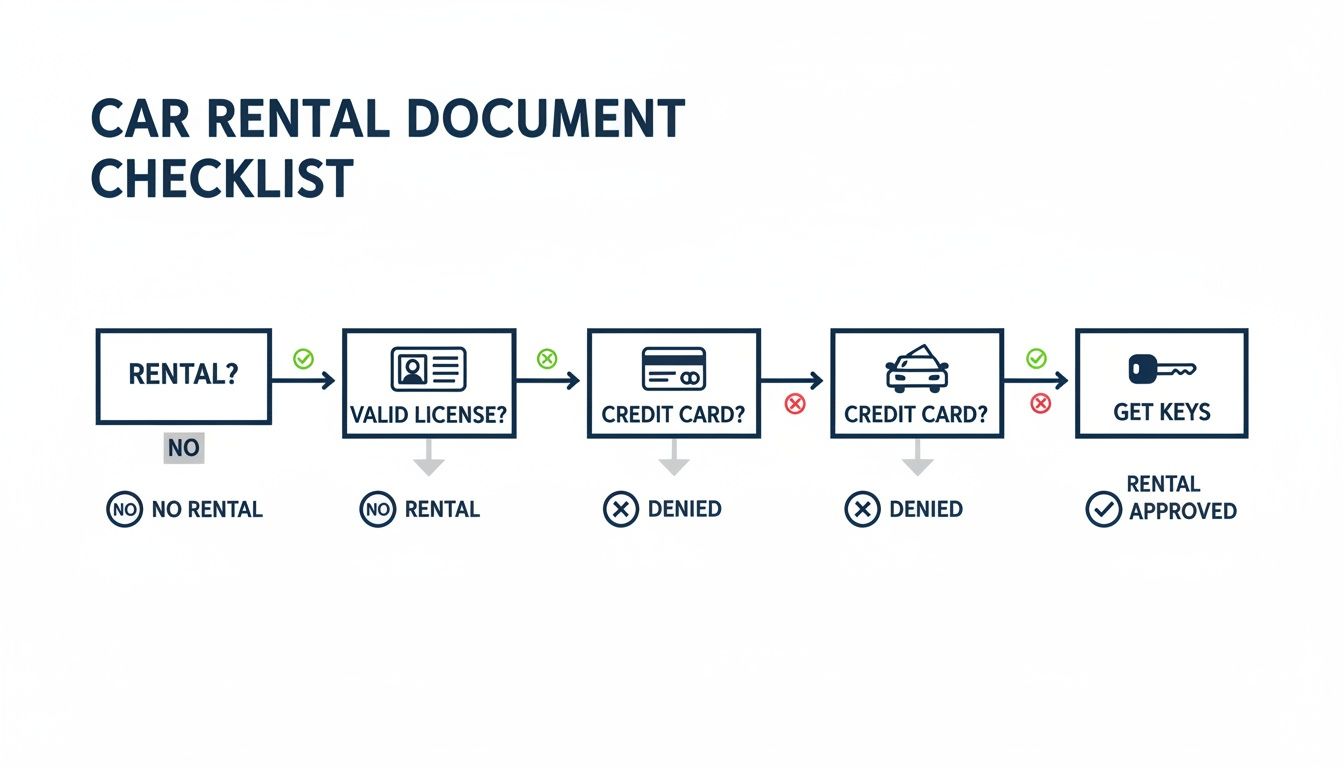
As you can see, a valid license and the right form of payment are the two make-or-break points in the process. Get those right, and you're well on your way.
To make it even simpler, here’s a quick rundown of the must-haves for your wallet.
Quick Checklist: Your Must-Have Rental Documents
Document | Why It's Required | Key Detail |
|---|---|---|
Valid Driver's License | Proves you are legally allowed to drive. | Must be a physical copy, not a photo. Make sure it's not expired! |
Credit/Debit Card | Secures the rental and covers the security deposit. | The cardholder's name must match the driver's license exactly. |
Reservation Confirmation | Speeds up the process and locks in your rate. | Have it ready on your phone or as a printout. |
Having these three items ready to go will cover about 95% of what you'll need at the counter.
The Core Two Documents
Across the board, the standard requirement is a government-issued driver's license and a credit or debit card in the primary renter's name. It's the universal rule for a reason: it allows rental companies to verify you're legally able to drive and to secure a financial hold for the car.
One thing that trips people up is relying on a digital copy. Major companies are almost always going to insist on seeing your physical license, so don't leave it at home.
As part of the check-in, you might also be asked to electronically sign important documents like the rental agreement, so it helps to be prepared for that.
Why These Documents Matter
So, why are rental agencies so strict? It's all about managing risk. Your driver's license is their proof that you're not a liability on the road.
The credit card does double duty. First, it's another form of ID. Second, and more importantly, it lets the company place a security hold—a temporary charge that can range from $200 to $1,000 or more. This hold covers them for potential extras like refueling, tolls, late fees, or minor damages. Without these two pieces of the puzzle, the company simply can't trust you with a vehicle worth thousands of dollars.
Understanding Driver's License and Age Requirements

When you walk up to that rental counter, two things matter more than anything else: your driver's license and your age. Think of it from the rental agency's perspective—they're handing over a valuable asset, and these are their primary tools for gauging risk.
Getting these details wrong is the quickest way to have your reservation denied on the spot. Your license and age are like your driving resume, and the company wants to see a history of experience and maturity before they hand you the keys.
The Fine Print on Your Driver's License
Your driver's license is the star of the show. It has to be the physical, government-issued card—not a picture on your phone, not a temporary paper copy, and definitely not expired. Any of those will get you a polite but firm "no."
Another crucial detail? The name on your license must be an exact match to the name on the credit card you're using. No exceptions.
Beyond the Expiration Date
But here’s a detail that trips up a lot of people: it’s not just about being valid. Some agencies have rules that aren't always obvious. For instance, many require you to have held your license for at least a year, sometimes two. This is their way of making sure you aren't a complete beginner behind the wheel.
This rule pops up frequently for international travelers or if you're trying to rent a high-performance or luxury car. A brand-new license, even if you’re well over 25, can be a deal-breaker.
Key Takeaway: Always bring your original, physical driver's license. If you're a newly licensed driver, double-check the rental company's policy on the minimum time you must have held your license before you book.
Navigating Age-Related Rental Rules
Age is the other big hurdle. You might be able to legally drive at 16, but you won’t be renting a car anytime soon. Most major companies set their minimum rental age at 21, and for premium or specialty vehicles, that often jumps to 25.
If you’re under 25, get ready to hear about the "Young Driver Surcharge." It’s a daily fee tacked onto your bill to cover the statistically higher accident risk for younger drivers. This fee isn't chump change, either—it can run anywhere from $10 to $50 per day. A week-long trip could easily cost you an extra $350 just for being young.
These policies are standard across the globe. It's common for renters under 25 to face these daily fees, and in some places, they won't rent to anyone under 21 at all. Don't be surprised if the company also runs a quick check on your driving record. To avoid any nasty surprises at the counter, it’s always a good idea to dig into the specific car rental requirements for your chosen company and location.
Renting a Car Abroad With Confidence
Taking your road trip to another country adds a couple of extra steps to the rental process, but don't worry—they're easy to handle with a bit of prep. When you're renting outside your home country, your regular driver's license often needs a couple of travel buddies to be accepted. That's where your passport and a handy document called an International Driving Permit (IDP) come into play.
Think of an IDP as a certified translation of your driver's license, not a replacement for it. It’s a small, official booklet that lays out your driving credentials in several languages, making it crystal clear for rental agents and authorities abroad to understand your info. It’s your ticket to avoiding language barrier headaches at the rental counter.
When an IDP Is Non-Negotiable
So, is an IDP always necessary? It really depends on where you're going and what your license looks like. If your driver's license isn't printed in the Roman alphabet (the one we use for English), an IDP is pretty much always mandatory. For everyone else, it’s still a smart, "better safe than sorry" move.
An International Driving Permit is recognized in over 150 countries. Just remember, it's only valid when you present it alongside your original driver's license—it can't be used on its own.
Showing up without an IDP where it's required can stop your trip dead in its tracks. A lot of rental agencies will flat-out refuse to give you the keys, leaving you stuck without a car.
Your Passport: The Ultimate ID
While your license proves you’re qualified to drive, your passport proves who you are on a global scale. For international car rentals, a passport is the go-to form of identification. Rental companies use it to verify your name, age, and home country, matching it against the details on your license and credit card.
Having your passport ready to go simply makes the whole pickup process faster and smoother. For international visitors coming to explore one of our car rental locations in Florida, a valid passport is a must-have, setting you up for a hassle-free start to your trip.
When you're renting overseas, packing both your passport and an IDP is a small step that can save you a massive headache. Major rental companies almost always require a passport from non-resident renters, and the IDP is a firm requirement if your license isn't in the Roman alphabet. For the millions of people booking rental cars for international travel, arriving without these documents is a common and completely avoidable reason for a denied rental. You can learn more about these international rental requirements to make sure you're covered. Getting an IDP is a quick, inexpensive task that delivers a whole lot of peace of mind.
Choosing The Right Payment Method
When you're standing at the rental counter, the card you hand over is more than just a way to pay. It’s your financial handshake with the company—a guarantee that you're a responsible renter. It’s not just about covering the rental fee; it’s about giving them peace of mind before they give you the keys.
One rule is set in stone: the name on the card must match the name of the primary driver on the rental agreement. This is a non-negotiable step to prevent fraud. If the names don't match, you're almost guaranteed to be turned away, which is a frustrating start to any trip.
Why Credit Cards Are King
There's a reason rental agencies love credit cards. They make it incredibly simple to place a temporary authorization hold, which you probably know as a security deposit. This isn't a charge that immediately takes money from you; instead, it's a block on your credit limit to cover potential extras like unpaid tolls, a low fuel tank on return, or minor dings and scratches.
This hold is standard practice across the board. The amount can be anywhere from $200 to $500 for a typical car, but expect that number to jump for luxury vehicles or if you opt to use a debit card.
What is an Authorization Hold? Think of it like reserving a table at a restaurant. The restaurant knows you're coming, and the rental company knows you have the funds available if they're needed. The hold is released once you return the car safely, though it can take a few business days for your available credit to go back to normal.
The Challenges Of Using A Debit Card
Can you rent a car with a debit card? Often, yes, but be prepared to jump through a few more hoops. Since debit cards pull money directly from your bank account, rental companies view them as a bigger risk. It’s harder for them to recover funds if something goes wrong.
To protect themselves, they usually add extra requirements for debit card users:
More Paperwork: You might need to show proof of a return flight or provide additional forms of ID.
Credit Checks: Some agencies will run a quick, on-the-spot credit check.
Limited Car Choices: Forget the convertible; you may be restricted to economy or standard sedans.
Bigger Holds: The security deposit is almost always higher for debit cards, tying up more of your actual cash.
To give you a clearer picture, here’s how the two payment methods usually stack up.
Credit Card vs Debit Card Rental Requirements
Feature | Credit Card | Debit Card |
|---|---|---|
Security Hold | Standard hold amount (e.g., $200-$500) | Larger hold amount, tying up cash from your bank account |
Vehicle Access | Access to all vehicle classes, including luxury and specialty cars | Often restricted to economy or standard-sized cars |
Additional Checks | Rarely requires additional checks beyond a valid card and ID | May require a soft credit check at the counter |
Extra Documents | Typically none required | Often requires proof of a round-trip ticket or extra ID |
Ultimately, a credit card provides the smoothest and most predictable experience.
As you plan your budget, don't forget that the daily rate is just one part of the total cost. You might find a general sales tax calculator helpful for getting a rough idea of what taxes could add to your final bill. Here at Cars4Go, we keep it simple. We gladly accept both credit and debit cards, and the prices you see online are what you'll pay. To see what works best for your trip, take a look at our current car rental deals for straightforward pricing.
Navigating Insurance and Adding Other Drivers
Let's be honest, insurance is probably the most confusing part of renting a car. But it doesn't have to be. The moment you drive off the lot, you're legally responsible for that vehicle, so the rental company needs to know you're covered if something happens.
You generally have three ways to handle this: use your personal auto insurance, lean on your credit card’s rental benefits, or buy a damage waiver from the rental company at the counter. Each one has its own paperwork and fine print.
Using Your Own Insurance Policy
If you're planning to use your own car insurance, you'll need to show proof at the counter. A digital copy of your insurance card on your smartphone or a printed declarations page from your policy is usually all you need. This just confirms your policy is active and shows your coverage limits.
Before you even get to the counter, give your insurance agent a quick call. You’ll want to double-check that your coverage actually extends to rental cars. Some policies have limitations on the type of vehicle or the length of the rental period.
Pro Tip: Never assume your policy covers everything. Make sure to ask specifically about "loss of use" fees. Rental companies charge these to cover the income they lose while a damaged car is in the repair shop, and it's a detail many personal policies don't include.
Adding Another Driver to the Agreement
Taking turns driving on a road trip? Smart move. But anyone who plans to drive that rental car must be officially listed on the rental agreement as an additional driver. Skipping this step can be a huge, costly mistake if there's an accident.
The process itself is simple, but there's one non-negotiable rule: all drivers must be physically present at the rental counter when you pick up the car. You can't add someone over the phone later or once you've already left.
Each person will need to show their own valid, physical driver's license to the agent. They’ll check it, add the name to the contract, and you're good to go. Most rental companies charge a daily fee per extra driver, which can really add up. Here at Cars4Go, we include a second driver for free to make things easier. This small step ensures everyone is properly covered, giving you total peace of mind for the journey ahead.
Common Questions About Renting a Car
Even when you think you've got everything packed and ready, a few last-minute questions can creep in and cause some serious stress at the rental counter. Let's tackle those nagging "what if" scenarios head-on so you can walk in with total confidence.
Think of this as your quick-reference guide for those tricky situations, making sure you know exactly what documents you need to rent a car and how to sidestep common rental headaches.
Can I Use a Digital Driver's License?
This is a popular question now that more states are rolling out digital IDs. The short answer? Almost certainly no.
While it’s handy to have a digital version on your phone, rental car companies are still old-school on this one. Their policies and verification systems are built around the physical, plastic card. To avoid any trouble, just assume your physical driver's license is the only one that matters. Always bring it with you.
What if My License Is in a Different Language?
If your driver's license isn't in the Roman alphabet (the one used for English), you're going to need an International Driving Permit (IDP). It’s not complicated—the IDP is simply an official, multi-language translation of your home country's license. It helps the rental agent quickly confirm your details.
Just remember, the IDP is a companion document, not a replacement. You must have both your original driver's license and your IDP with you at the counter.
Crucial Reminder: An IDP is useless on its own. If you have the permit but forget your actual license, you won't be driving off the lot.
Do I Need Proof of Address?
Sometimes, yes. This usually comes up in two specific situations: if you’re paying with a debit card or if you're a "local renter" (meaning you live in the same area you're renting from). The company might ask for something like a recent utility bill or bank statement with your name and address on it.
It's really a fraud prevention step on their end. It’s not a standard requirement for most travelers paying with a credit card, but it's smart to check the fine print if you're a local or plan to use a debit card. To get a better sense of who might need this, you can learn more about the typical car rental customer profile and what they experience.
At Cars4Go, our goal is a surprise-free pickup. We're always upfront about what you need to bring, so the process is as smooth as possible. For a straightforward rental experience in Florida, book your next trip with us at https://www.cars4go.com.
Comments