


Car Rentals Without Credit Card: Learn car rentals without credit card options
- fantasma70
- Dec 27, 2025
- 16 min read
It’s a common misconception that you absolutely need a credit card to rent a car. The good news? That’s just not true anymore. While it used to be the iron-clad rule, the rental industry has evolved, and getting a car rental without a credit card is now a real option for many people.
Major rental companies have realized that not everyone uses credit and are now widely accepting debit cards, which is a game-changer for a lot of travelers.
Your Guide to Renting a Car Without a Credit Card
For the longest time, the rental counter felt like an exclusive club where a credit card was your only membership pass. It was the industry's go-to security blanket, protecting them from everything from dings and dents to unpaid tolls. But things have changed. People's financial habits have shifted, and millions now prefer using debit cards to avoid accumulating debt.
The car rental world has caught on. While having a credit card can still make the process a bit quicker, using a debit card is now a perfectly normal way to rent. This is great news for a whole bunch of people, including:
Younger renters who haven't built up a long credit history yet.
Travelers from overseas whose foreign credit cards might not always work smoothly.
Anyone who's budget-savvy and likes paying with money they have on hand.
Why Credit Cards Were the Gold Standard
So, why was the industry so stuck on credit cards? It all came down to security. A credit card allowed the rental company to place a temporary "hold" on your credit line for the security deposit. This wasn't an actual charge, just a guarantee that the funds were available if they needed them for things like refueling the car or covering a damage deductible. It was simple and effective.
The Debit Card Option Steps In
As debit cards (especially those with a Visa or Mastercard logo) became more common and secure, they started looking like a much better alternative. Rental agencies just needed to adjust their process to manage the risk. That’s why you’ll find a few extra hoops to jump through when you use a debit card.
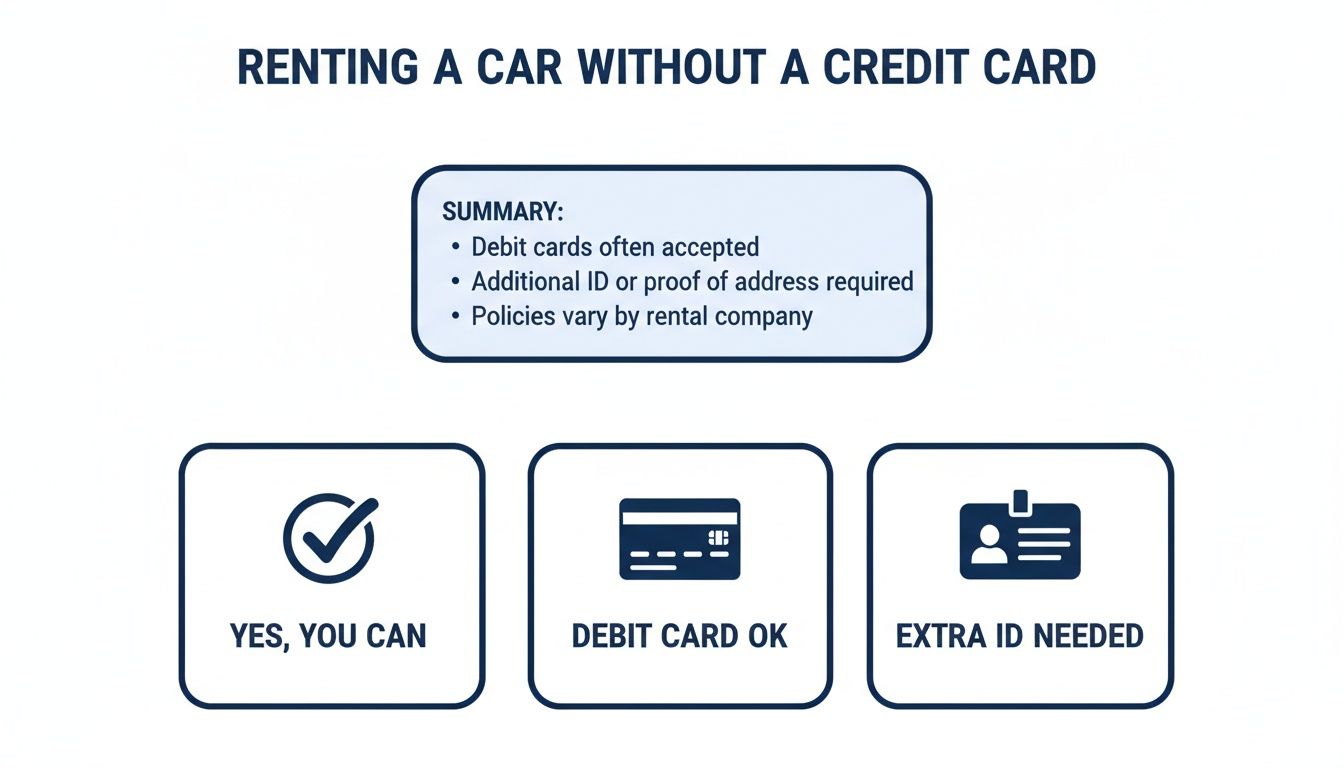
The Bottom Line: You can definitely rent a car with a debit card, but you'll need to do a little more prep work. Be ready for things like a larger security deposit (which will be an actual hold on the funds in your bank account), providing extra forms of ID, and sometimes even a quick, soft credit check.
This guide will walk you through everything you need to know to make it happen. We'll cover the exact documents to bring to the counter and the common mistakes to watch out for. It might seem like a lot, but with the right info, you’ll be on the road in no time.
For more helpful travel guides and rental tips, check out the articles on the Cars4Go blog. Our goal is to take the mystery out of car rentals without a credit card so you can travel with confidence.
How to Rent a Car with a Debit Card: What You Actually Need to Know
Using a debit card to rent a car is totally possible, but it's not quite as simple as using a credit card. Rental companies have their own rules, and they're mainly in place to protect themselves. Don't think of it as a roadblock—just a different set of steps to get your keys.
First things first, your debit card almost always needs a Visa or Mastercard logo. This is non-negotiable for most agencies, as it allows them to place holds and process payments just like a credit card. A standard ATM card without one of these logos probably won't cut it.
Age and Location Can Make or Break Your Rental
Two of the biggest hurdles you’ll face are your age and where you plan to pick up the car.
It's an industry standard for many major rental companies to require debit card users to be 25 or older. This all comes down to their risk assessment and insurance policies. If you're under 25, you’ll often find that a credit card is your only option.
Where you rent from matters, too. Airport locations are often a bit more flexible with debit cards, mainly because they can confirm you have a round-trip ticket. A neighborhood branch, on the other hand, might have much stricter rules because the risk profile of renters is different.
My best piece of advice: Never assume the national policy on a website applies to the local branch. Always, always call the specific location where you’ll be picking up the car to confirm their debit card rules. A quick five-minute phone call can save you a world of frustration at the counter.
Brace for the Security Hold
This is the single biggest difference between using a debit and credit card. A credit card hold simply ties up part of your available credit. A debit card hold, however, freezes actual cash in your checking account. That money is gone—you can't touch it until the hold is released.
The hold amount can be pretty steep, often ranging from $200 to $500, or sometimes even the full estimated cost of the rental plus an extra couple hundred dollars. You absolutely must have enough cash in your account to cover both the rental and this hold. If you don't, they can turn you away right there on the spot.
And be patient on the other end. After you return the car, it can take anywhere from 5 to 10 business days for the rental company to release the hold and for your bank to process it. Factor this delay into your travel budget so you're not caught short on cash.
Renting with a debit card just means you need to be a little more prepared with your paperwork to prove you're a reliable customer.
What Documents to Bring to the Counter
When you show up with a debit card, expect to provide more proof of identity than just your driver's license. The rental agent needs to verify you are who you say you are and that you're a low-risk renter.
Get these documents ready ahead of time:
Proof of a return trip: An itinerary showing your flight, train, or bus ticket is often mandatory, especially at airport locations.
A recent utility bill: Make sure it has your name and current address, and that it matches what's on your driver's license.
A recent pay stub: Some agencies want to see proof of employment.
A second form of ID: A passport or other government-issued ID is a solid choice.
Having this folder of documents ready will make the check-in process a thousand times smoother.
How Different Companies Compare
Comparing policies between rental companies can feel overwhelming. To make it easier, here’s a quick look at what you can generally expect from the big national chains versus a more debit-friendly company like Cars4Go.
Debit Card Rental Policy Comparison
Policy Requirement | Major National Chains (Typical) | Cars4Go Rent A Car |
|---|---|---|
Minimum Age | Usually 25+ for debit card use | 18+ with no young driver fees |
Credit Check | Often required (soft pull) | No credit check required |
Security Hold Amount | $200 - $500+ on top of rental cost | Flat, transparent deposit amount |
Proof of Residence | Utility bills often required | Driver's license is sufficient |
Proof of Travel | Return flight itinerary frequently needed | Not required |
Card Type | Must be linked to a bank account | Bank debit, prepaid cards, and cash |
As you can see, policies vary a lot. While major brands are slowly becoming more accommodating, specialized companies are often built from the ground up to serve debit card and cash renters.
Don't Forget About Insurance
One last crucial point: most credit cards come with some form of built-in rental car insurance. Debit cards almost never do. This means you're on your own for coverage. Before you get to the counter, you need to understand your options, from your personal auto policy to the waivers the rental company offers. For a really clear breakdown, check out this guide on insurance when renting a car. Knowing what you need ahead of time will help you avoid paying for expensive, unnecessary coverage.
Booking Your Car with a Debit Card
Knowing you can rent a car with a debit card is one thing, but actually doing it smoothly is another. With just a little bit of prep work, you can make the entire process completely painless. This is your practical guide to getting from your computer screen into the driver's seat without a hitch.
Your first move is to start your search online. As you browse, be intentional about finding companies that openly welcome debit cards. Most of the big rental websites have search filters that let you specify your payment method. Use them! It’s the easiest way to weed out the credit-card-only options and avoid the frustration of finding the perfect car only to hit a payment wall.
But don’t just stop at the search filter. A company’s main website might state a general, corporate-wide policy, but the rules can—and often do—change from one franchise location to the next. This is especially common when comparing airport branches to off-airport neighborhood locations.
The Most Important Step: Make a Phone Call
I can't stress this enough: once you find a promising rental agency, pick up the phone and call the exact branch where you'll be picking up the car. An online policy is a guideline; a conversation with the local manager is a guarantee.
When you get them on the line, be direct. You're not bothering them—you're being a prepared customer. Here's a simple script that works every time:
"Hi, I'm looking to book a car for [your dates] and I plan to pay with my Visa debit card. Can you confirm that you accept debit cards for both the rental and the security deposit at your specific location? Also, could you tell me the exact security hold amount and what documents I'll need to bring besides my license?"
This one quick call knocks out three crucial things:
Confirms the Policy: You get a definite "yes" or "no" straight from the source.
Clarifies the Deposit: You’ll know the exact hold amount, so you can make sure you have enough in your account.
Details the Documents: You’ll learn precisely what paperwork to have ready, so there are no last-minute surprises at the counter.
The global car rental market is expanding fast, with projections showing it could reach 644.4 million users by 2028. This boom is pushing companies toward more payment flexibility. While credit cards still dominated 85% of bookings as of March 2025, that other 15% represents a growing acceptance of alternative methods, opening up travel for people who prefer debit.
Getting Your Paperwork in Order
Okay, you've got confirmation. Now it's time to gather your documents. Think of it like packing for a flight; having everything organized makes the check-in process a breeze. While a debit-friendly company like Cars4Go keeps things simple, many of the big national brands will want a folder of paperwork to verify your identity and cover their risk.
Your Debit Card Rental Checklist:
Valid Driver's License: This is the absolute must-have. Make sure it’s not expired and the photo is clear.
The Debit Card Itself: It has to be in your name and carry a Visa or Mastercard logo.
Proof of Address: This usually means a recent utility bill or bank statement (from the last 30-60 days) where the name and address match your license.
Proof of Return Travel: If you’re renting from an airport, have your return flight info printed or saved on your phone.
A Second Form of ID: A passport or another government-issued photo ID is a common request.
Having these documents ready to go will make you look like a pro at the rental counter and speed everything up. Check out our various car rental locations to find a branch that works for your travel plans.
What to Expect at the Rental Counter
You did the prep work, and now it's go-time. When you get to the counter, the agent will walk you through the rental agreement. Pay close attention to two things: insurance and the security deposit.
They will almost certainly offer you the company’s own insurance coverage. It’s smart to know your options before you get there—figure out if your personal auto policy covers rentals or if you need to buy theirs.
Next, the agent will process your payment and authorize the security hold on your debit card. Before you sign a single thing, ask them to confirm the exact hold amount and point it out on the receipt. This little step prevents any misunderstandings about how much of your money will be temporarily locked up.
Finally, before you even think about driving off, do a walk-around of the car. Use your phone to take pictures and a quick video of its condition, inside and out. Note every single scratch, dent, or scuff. This creates a timestamped record that protects you from being blamed for pre-existing damage when you bring the car back.
Don't Get Sidetracked: Common Pitfalls to Avoid
Knowing what can go wrong is half the battle. Renting a car without a credit card is actually pretty simple once you know the ropes, but a few common missteps can easily throw a wrench in your travel plans. If you sidestep these classic mistakes, you're setting yourself up for a smooth ride from the rental counter to your final destination.
Assuming All Locations Play by the Same Rules
This one trips people up all the time. You see a debit-card-friendly policy on the company's main website and assume you're good to go anywhere. That's a classic mistake. While the corporate office might give the green light, an individual franchise owner at the airport or your local neighborhood branch can have their own, much stricter rules.
I've seen it happen: a traveler books online, shows up ready to go, and gets hit with a "sorry, this location requires a credit card" right at the counter. The fix is incredibly simple but so important: always call the local office directly before you even think about booking. A quick five-minute phone call can save you from a world of frustration.
Underestimating the Security Hold
The security hold is probably the biggest financial hurdle when you use a debit card, and not planning for it is a critical error. A credit card hold is just a temporary authorization against your credit limit. A debit card hold, on the other hand, freezes actual cash right out of your checking account.
That means you need enough money in your account to cover the entire rental cost upfront, plus the security deposit, which can easily be $200, $500, or more. If the total amount isn't there, they'll likely cancel your reservation on the spot, leaving you high and dry.
Here’s how to stay ahead of it:
Get the Exact Number: When you call the local branch, ask for the precise hold amount. Don't guess.
Pad Your Account: Make sure you have more than enough to cover everything well before your pickup day.
Plan for the Delay: Don't forget, it can take 5-10 business days for that hold to be released after you return the car. That money won't be available for gas, food, or other travel expenses right away.
Overlooking the Fine Print on Cars and Insurance
Another unwelcome surprise many renters run into is vehicle restrictions. You might be dreaming of a convertible for your coastal drive, only to find out at the counter that debit card rentals are limited to basic economy or standard sedans. It's common for agencies to keep their premium, luxury, and specialty cars for credit card customers because they see it as a lower risk.
A good rule of thumb: the nicer the car, the more likely you'll need a credit card. Always double-check that the car class you want is even an option for debit card renters to avoid a last-minute letdown.
Insurance is another big one. Many credit cards offer some form of rental car coverage as a perk, but your debit card almost certainly doesn't. This puts the responsibility for insurance squarely on your shoulders. Some rental agencies might even require you to buy their pricey daily insurance waiver unless you can show proof of your own comprehensive auto policy. Be sure to ask about their insurance rules beforehand so you don’t get backed into a corner and forced to pay for a policy you don't need.
With travel booming again, people are booking cars much closer to their travel dates. The average booking window dropped from 49.54 days in early 2024 to just 41.98 days by March 2025, with same-day bookings hitting a peak of 16%. In this fast-moving rental market, having all your ducks in a row with your payment method is a huge advantage, especially for spontaneous trips. For more tips on this, you can learn more about how to navigate these trends and rent a car without a credit card from industry experts.
How to Spot a Truly Renter-Friendly Company

When you're looking for car rentals without credit card options, you’ll quickly learn that not all agencies are the same. Sure, a lot of the big-name companies now accept debit cards, but their policies can feel like they were written by lawyers. They’re often packed with restrictions and hoops to jump through.
A genuinely renter-friendly company, on the other hand, builds its entire process around making things easier for you, not just covering its own risks. It’s about more than just a “we accept debit” sticker on the window; it's about the entire experience.
Look for Absolute Transparency
The first thing to look for is a company that’s upfront about its pricing. Nothing sours a trip faster than getting hit with surprise debit card fees at the counter or finding out the rate you booked online has suddenly changed. The price you see should always be the price you pay.
At Cars4Go in Miami, we built our business on this idea. Choosing to pay with a debit card shouldn't come with a penalty. That’s why the rate you book online is the rate you get at the counter, with no hidden surcharges. It keeps your travel budget exactly where you planned it.
Perks That Actually Make a Difference
Another tell-tale sign of a great rental company is the extras they include without charging you an arm and a leg. These are the thoughtful amenities that can turn a good rental experience into a great one, especially if you're traveling with family or navigating a new city.
Here are a few perks that provide real value:
Complimentary Second Driver: Why should you pay extra just to share the driving on a road trip? The best companies include this for free.
No-Cost Car Seats: Traveling with kids is already a production. A company that offers free car seats really understands what families need.
Free GPS Units: Instead of burning through your phone’s data and battery, a dedicated GPS unit makes exploring unfamiliar roads stress-free.
These aren’t just small bonuses; they can save you a significant amount of money and add a whole lot of convenience.
The rental car world is finally catching up to how people actually pay for things. As more travelers opt for debit, credit card usage is expected to drop from 90% of global bookings in March 2024 to 85% by March 2025. This shift is paving the way for more flexible companies like Cars4Go. You can learn more about these car rental market shifts and what it means for your next trip.
Convenience That Comes Right to You
Finally, the ultimate mark of a renter-friendly company is one that works on your schedule, not the other way around. Let’s be honest, nobody wants to start their vacation by waiting in a long line at a crowded rental counter after a long flight.
Instead, picture your rental car being delivered directly to you—whether you’re at the airport terminal, your hotel, or even an Airbnb. This kind of door-to-door service changes the game, turning a necessary chore into a seamless part of your travel plans. It’s a clear sign that a company is willing to go the extra mile. Many of our customers have said this one service made all the difference, and you can see what they have to say in our customer reviews.
Got Questions? We've Got Answers
Renting a car without a credit card can feel like it comes with a lot of "what-ifs." It's totally normal to have questions. After all, it's a bit different from the standard rental process. We've heard just about every question in the book, so we’ve put together some straight-to-the-point answers to clear things up.
Think of this as your quick guide to navigating the details, so you can book your car and get on the road without any second-guessing.
What About Using a Prepaid Card?
This one comes up a lot, and the short answer is almost always no. While you can use a prepaid card for your morning coffee, rental car companies just don't accept them for bookings or security deposits.
The reason is pretty simple: they can't verify who you are or your financial stability through a prepaid card. It’s not linked to a bank account, which makes it impossible for them to place a security hold or charge for things like extra mileage or damage. To avoid a dead end at the rental counter, stick with a traditional debit card from your bank that has a Visa or Mastercard logo.
Will Renting with a Debit Card Ding My Credit Score?
Here’s some good news: renting with a debit card will not affect your credit score.
The rental company isn’t extending you a line of credit, so there's no reason for them to run a "hard pull" on your credit history. Some agencies might do a soft credit check just to verify your identity, but these aren't visible to lenders and have zero impact on your score.
The Bottom Line: Your rental transaction—from the security deposit to the final payment—is all handled through your bank account. No credit bureaus are involved. You can rent worry-free, knowing your credit report is completely untouched.
This makes using a debit card a great option if you're working on building your credit or just prefer to keep things simple and pay as you go.
My Security Hold Hasn’t Been Released. Now What?
This is easily one of the most frustrating parts of renting with a debit card. You’ve returned the car, paid up, but hundreds of your own dollars are still stuck in limbo.
First, take a deep breath. It’s rarely instant. It typically takes 5 to 10 business days for the hold to be released and the funds to reappear in your account.
If you're past the 10-day mark, it's time to take action:
Call the Rental Location First: Get in touch with the exact branch where you picked up the car. Have your rental agreement number ready and ask them to confirm they’ve processed the release on their end.
Then Call Your Bank: If the rental company gives you the green light, the hold-up is likely with your bank. Call their customer service line, explain the situation, and see if they can see the pending release. Sometimes, a nudge from you can speed things up.
Hold Onto Your Paperwork: Don't throw away your final receipt or any emails from the rental company. This is your proof that you’ve settled your bill and the hold should be gone.
Are Some Cars Off-Limits for Debit Card Renters?
Yes, absolutely. This is a common policy you'll run into, and it's all about managing risk for the rental company.
When you use a debit card, you can usually expect to be restricted from renting:
Luxury and premium vehicles (think convertibles, high-end Audis or BMWs)
Specialty vehicles like large 12-passenger vans or big SUVs
Sports or performance cars
Most companies will happily rent you an economy, compact, or standard sedan. The thinking is that these cars are less of a financial risk if there's an accident. If you've got your eye on a fancier ride for your trip, you'll almost certainly need to use a credit card. Always double-check which cars are available for debit card renters when you call the branch to confirm their policy.
Ready to experience a hassle-free rental in Miami? At Cars4Go Rent A Car, we make renting without a credit card simple and transparent. Book your perfect vehicle today and enjoy our complimentary perks and door-to-door service. Book your Miami rental car now.
Comments