


Can I Take a Rental Car to Canada? Your Guide
- fantasma70
- Oct 18, 2025
- 10 min read
Yes, you can absolutely drive a rental car from the US to Canada. The short answer is a resounding "yes," but the longer answer involves a little bit of homework.
The key is to make sure you have explicit, written permission from the rental car company before you even point the car north.
Why Planning Your Cross-Border Rental Is Essential
Driving a rental car over the border isn’t quite as simple as just booking a sedan and hitting the road. Think of it less like a spur-of-the-moment trip and more like a move that requires a bit of coordination. Without the right paperwork, you could run into some serious headaches.
The single most important document you'll need is your rental agreement. It absolutely must state that you're allowed to take the vehicle into Canada. This piece of paper is your proof for border officials that you have the company’s blessing for the trip.
Hurdles To Clear Before You Go
Before you even get the keys, you need to know about a few potential roadblocks. Every rental company plays by its own rules, and they can be wildly different from one another. Knowing what to look for is the secret to a smooth crossing.
You'll want to get clear answers on these three things:
Company Policy: Does the agency even allow its cars into Canada? Most big names like Hertz or Enterprise are fine with it, but you can't assume. Smaller, local companies might not be.
Vehicle Restrictions: Some cars just aren't allowed to cross. It's common for companies to prohibit 15-passenger vans, cargo vans, and some high-end luxury models from leaving the country.
Geographic Limitations: You might find that a company allows travel into Ontario and British Columbia but not, say, Newfoundland. Always double-check that your destination province is on the approved list for any of their **car rental locations**.
To help you keep track of everything, here’s a quick checklist to run through with your rental company before you book.
Cross-Border Rental Checklist
Requirement | What You Need to Do | Why It Matters |
|---|---|---|
Company Permission | Verbally confirm and get it in writing on your rental agreement that you can take the car to Canada. | Border agents will ask for this. No permission, no entry. |
Vehicle Type | Ask if the specific car class you want (e.g., SUV, luxury) is allowed across the border. | Certain vehicles are often excluded from cross-border policies. |
Location Coverage | Check if there are any restrictions on which Canadian provinces you can visit. | Your insurance or roadside assistance might be void in unapproved areas. |
This might seem like a lot, but a quick phone call can clear up all these points.
The biggest mistake people make is just assuming any rental car can go to Canada. Always, always verify the cross-border policy directly with the rental agency before you pay for anything. It’s the best way to avoid a nasty surprise at the border crossing.
Getting these details sorted out early is the difference between a frustrating ordeal and a fantastic, stress-free road trip.
Your Essential Cross-Border Document Checklist
Nothing ruins a road trip faster than getting turned away at the border because of a missing piece of paper. It's a traveler's nightmare, but thankfully, an easy one to avoid. Let's walk through exactly what you need.
Of course, you'll need your personal ID. A valid passport is the gold standard. However, U.S. citizens can also use other documents like a NEXUS card, a Passport Card, or an Enhanced Driver's License to prove their citizenship.
Documents for the Rental Car
Once your personal ID is sorted, the focus shifts to the car itself. Think of your rental agreement as the most important document in the glove box. It must clearly state you have permission to drive the car into Canada. If that authorization isn't in black and white, border officers have every right to deny you entry.
Just as critical is a specific document called the Canadian Non-Resident Inter-Province Motor Vehicle Liability Insurance Card. It’s a mouthful, I know. Most people just call it the "yellow card," and it's your proof that the car is properly insured for driving in Canada. Your rental company is responsible for giving this to you.
This infographic lays out the must-haves versus the nice-to-haves.
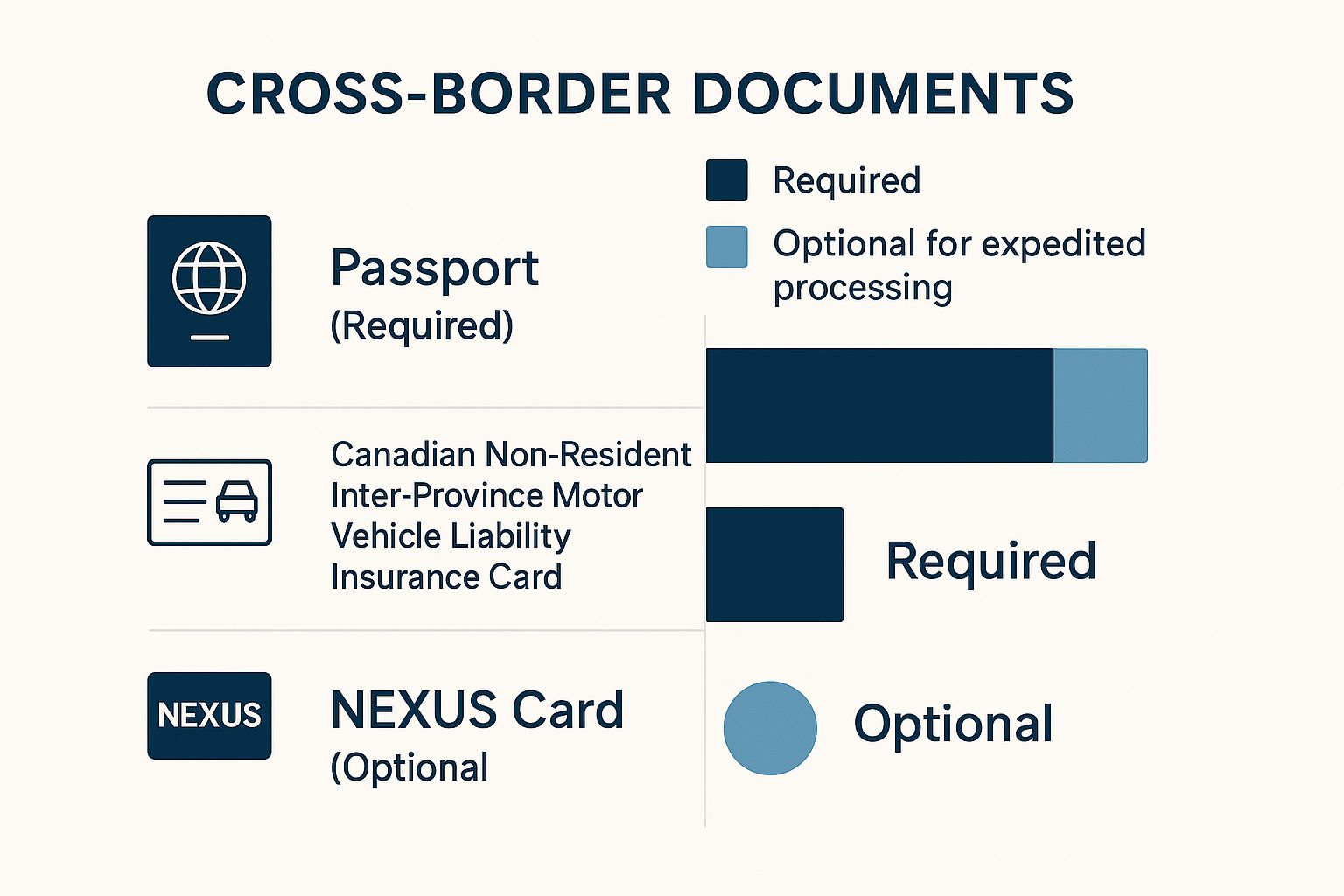
As you can see, your passport and that Canadian insurance card are non-negotiable. A NEXUS card, on the other hand, is a great optional tool for a faster crossing.
This isn't some new, obscure rule. People have been taking U.S. rentals into Canada for years, but the process has always hinged on having the right paperwork: valid proof of citizenship and that all-important non-resident insurance card. This card, issued by the U.S. rental agency, is required by Canadian law and must stay in the car at all times.
Key Takeaway: Treat your rental agreement and Canadian Non-Resident Insurance Card with the same importance as your passport. Before you even pull out of the rental lot, make sure you have both in hand.
Finally, it's smart to know the entry rules that apply to your specific nationality. If you're from a country that isn't visa-exempt, you might need an Electronic Travel Authorization (eTA). This is usually for air travel, but it's worth checking. You can find a detailed guide to Canada eTA requirements to see if this applies to you.
Choosing The Right Rental Company For Your Trip

So, you're ready to hit the road. But hold on—not all rental companies are on board with your international adventure. While the big names like Hertz, Avis, and Enterprise generally give the green light for driving into Canada, you can't assume their policies are identical.
Think of it like airline baggage fees; they're all over the map, and what works for one doesn't work for another. You absolutely have to confirm the cross-border policy with the exact branch where you're picking up the car. Policies can, and often do, change from one franchise location to the next, even under the same corporate banner.
Digging Into The Details
Getting a simple "yes" isn't enough. The real devil is in the details, and overlooking them can bring your trip to a screeching halt. Many rental companies have a "no-go" list of vehicles that can't leave the United States.
You'll often find these types of vehicles are restricted:
Large Passenger Vans: Those 12-15 passenger vans are almost always a no.
Cargo Vans: These are usually kept for local or commercial use only.
Exotic or Luxury Cars: Forget about taking that high-end sports car across the border.
These rules usually come down to insurance. Understanding the basics of **auto rental business insurance** can give you some insight into why companies are so protective of certain fleet vehicles and how it impacts your own coverage.
Geography can also throw a wrench in your plans. Some agreements might let you pop over into Ontario or British Columbia but draw the line at a cross-country trek to Newfoundland. And if you're thinking about a one-way rental to drop off in Canada? Good luck. They are incredibly rare and almost always come with eye-watering fees. It pays to shop around and compare different **car rental deals** to find a good fit.
Pro Tip: Don't be vague when you call to book. Ask this exact question: "I plan to drive a rental car to Canada. Can you confirm this specific vehicle class from this specific location is authorized for travel to [Your Destination Province]?" You need to hear a clear, unambiguous "yes" before you book.
Major Rental Company Cross-Border Policy Comparison
To give you a head start, here’s a quick rundown of what you can generally expect from the major players. Remember, these are typical policies—the golden rule is to always confirm with your specific rental location.
Rental Company | Cross-Border Permitted | Typical Fees | Common Restrictions |
|---|---|---|---|
Hertz | Yes, generally | Usually none | Luxury/exotic cars, 12-15 passenger vans, one-way rentals to Canada are very limited. |
Avis | Yes, generally | Usually none | Some vehicle classes (e.g., luxury cars, large vans) may be restricted. One-way rentals are rare. |
Enterprise | Yes, generally | Usually none | Exotics, large passenger/cargo vans are prohibited. Some locations may have geographic limits. |
As you can see, while the basic answer is often "yes," the specific vehicle you want to drive might be the sticking point. Always double-check before you put your credit card down.
Navigating Age Requirements and Driver Rules
When you're planning to take a rental car into Canada, your age isn't just a number. It's one of the first things you need to check, and the rules can be surprisingly strict and a bit confusing.
The biggest mix-up happens because you're dealing with two sets of rules: the U.S. rental company's policy and Canadian provincial law. While a province like Quebec might rent to an 18-year-old, the American company you rented from has the final say for a cross-border trip. Their rules almost always win out, and they're usually tougher.
The Under-25 Hurdle
Here's the most common roadblock: many major U.S. rental companies simply won't allow drivers under 25 to take a car into Canada. It doesn't matter if they let you rent for a road trip across the States; international travel is a different ballgame because of insurance and risk.
Don't assume your domestic rental policy applies internationally. You need to ask one very specific question: "Does your policy for drivers under 25 permit travel into Canada?" The answer might surprise you.
Canadian Rules You Still Need to Know
Let's say your rental company does give you the green light. You still have to play by Canada's rules once you're there.
In most of Canada, the minimum age to rent a car is 21. If you're under 25, you can also expect to pay a "young driver surcharge."
While some provinces like Saskatchewan and Quebec technically allow rentals from age 18, your U.S. rental company's stricter policy will almost certainly override this. You can learn more about these regional differences in rental car age requirements to get the full picture.
And here's a crucial detail that often gets missed: Canadian law requires all young drivers to have at least 12 months of driving experience. So, even if you meet the age minimum, a brand-new license won't cut it for that Canadian road trip.
Tips for a Smooth Border Crossing Experience

Alright, you've got the right car and the right paperwork. Now comes the moment of truth: pulling up to the customs booth. This is where a little preparation goes a very long way. How you handle this quick chat can mean the difference between a friendly wave-through and a lengthy delay.
Think of it less like an interrogation and more like a quick, professional check-in. The border officer’s goal is simple: to confirm you are who you say you are and that your trip is legitimate. The best thing you can do is make their job easy.
Have your passports, rental agreement, and the Canadian insurance card right there on the passenger seat or in the center console. You definitely don’t want to be digging through your luggage in the trunk while the line of cars behind you grows longer.
Preparing for Common Questions
The questions you’ll get are usually pretty straightforward, so don’t overthink it. Just be ready with clear, honest answers.
Purpose of Your Trip: Are you on vacation? Visiting family? Attending a conference? A simple "We're here for a week of sightseeing in Montreal" is perfect.
Duration of Your Stay: Know your exact return date. Saying "I'm not sure, maybe a week or two" can raise red flags. Be specific.
Your Destination: Have a clear destination in mind. For example, "We're heading to Toronto for a long weekend."
Keep your answers direct and polite. Answer what you're asked, but don't volunteer a novel's worth of information. A calm, confident demeanor is your best friend here.
The key is simply being prepared. When your documents are handy and your answers are clear, the whole process becomes routine. You’re making the officer’s job easier, and in return, they’ll get you on your way that much faster.
It's also worth noting that booking your cross-border rental car early is more important than ever. In the first quarter of 2024 alone, tourists spent $329 million CAD on rental cars in Canada, which is a 10.4% jump from the previous quarter.
With demand on the rise, waiting until the last minute might mean you can't find a vehicle that’s even allowed to cross the border. For a deeper dive into this trend in tourist spending on StatCan, you can check out the official data.
And for more travel tips and guides, head over to the Cars4Go blog.
A Few Common Questions About Driving a Rental to Canada
Even the best-laid plans can leave you with a few lingering questions. Let's tackle some of the most common "what ifs" that pop up when you're thinking about taking a rental car across the border.
Can I Book a One-Way Rental and Drop It Off in Canada?
You can, but it's often a logistical and financial headache. While some of the big rental companies offer one-way cross-border rentals, they are usually very expensive and not always available.
Expect to see a hefty cross-border drop-off fee tacked onto your bill, which can easily add hundreds of dollars to your trip. You absolutely have to confirm this with the rental agency directly when you book to find out the exact cost and availability.
What if I Don't Tell the Rental Company I'm Going to Canada?
Don't do it. Seriously. This is a huge gamble that can backfire in a major way. Driving into Canada without telling the rental company is a direct violation of your rental agreement.
The biggest risk? It can completely void all your insurance coverage. If you get into an accident, you’d be on the hook for 100% of the costs—damage, theft, you name it. A border officer could also check your paperwork and deny you entry on the spot. It's just not worth it.
What Happens if I Get in an Accident in Canada?
First things first, make sure everyone is safe and call local emergency services if you need to. Once the immediate situation is handled, your next call should be to your rental company's emergency roadside assistance line.
That Canadian Non-Resident Insurance Card you have is exactly for this kind of situation. Just be sure to follow the rental company's reporting process to the letter to make sure you're covered.
Do I Need to Buy Extra Insurance from the Rental Company?
Maybe not. While the rental company will give you the legally required liability card, it's always a good idea to see what other coverage you already have.
Before you fork over money for extra insurance at the counter, do two things:
Check your personal auto insurance policy to see if it extends to rental cars in Canada.
Call the number on the back of your credit card. Many travel credit cards include a Collision Damage Waiver (CDW) that works just fine in Canada, which could save you a decent amount of money.
Ready to plan your next road trip? Cars4Go Rent A Car offers a wide selection of vehicles perfect for any adventure. Book your car with transparent pricing and exceptional service today at https://www.cars4go.com.
Comments