


Best Cars for Family Road Trips A Complete Guide
- fantasma70
- Nov 18, 2025
- 16 min read
When it comes to the best cars for family road trips, the front-runners are usually spacious SUVs, versatile minivans, and increasingly, long-range electric vehicles (EVs). The right one for you really comes down to a balancing act between passenger comfort, how much stuff you need to bring, and fuel efficiency for your specific route.
Finding Your Ultimate Family Road Trip Vehicle
Picking the right vehicle is the first—and maybe most important—step in planning a great family adventure. Your car becomes more than just transportation; it’s your mobile basecamp for the journey, and the right choice can turn hours on the road into a genuinely fun part of the vacation.
And it seems most parents agree. A recent survey found that 95% of parents with kids at home actually look forward to road trips. That same study showed a big demand for capability, with many saying all-wheel drive (AWD) is a top priority. When it comes to the vehicle itself, 29% prefer 3-row SUVs, with 2-row models right behind at 28%. It’s clear that space and versatility are what families are looking for. You can explore more about parental road trip preferences to see how your own needs stack up.
Key Vehicle Categories at a Glance
To kick things off, let's look at the main contenders. An SUV might be the obvious choice for a mountain getaway, but a minivan is king when it comes to keeping everyone comfortable on a long haul across the country. And for families who don't mind planning around charging stops, an EV can offer a quiet, modern ride.
Each type comes with its own set of trade-offs.
The "best" vehicle is entirely situational. A family of three heading to a national park has vastly different needs than a family of six visiting relatives several states away. Focus on your trip's specific demands first.
To help you get started, here's a quick side-by-side look at the main options.
Quick Comparison of Family Road Trip Vehicle Types
This table gives a high-level summary of each vehicle type, showing where they shine and what to keep in mind. Think of it as a starting point to see which category aligns best with your family's priorities before we dig deeper.
Vehicle Type | Best For | Key Strengths | Primary Consideration |
|---|---|---|---|
SUV | Adventurous families needing all-weather capability or towing capacity. | Versatility, higher ground clearance, available AWD/4WD. | Cargo space can be limited when the third row is in use. |
Minivan | Maximizing passenger comfort and interior space, especially with young children. | Unmatched cargo room, easy access with sliding doors, family-friendly features. | Less rugged styling and capability compared to SUVs. |
Electric Vehicle (EV) | Tech-savvy families focused on lower running costs and a quiet ride. | Smooth performance, innovative features, spacious interiors due to design. | Requires careful route planning around charging infrastructure. |
Now that you have a general idea of the landscape, we can get into the nitty-gritty of what really makes a car great for life on the road.
What to Look for in a Great Road Trip Car
Before you even think about specific models, let's figure out what actually makes a car great for a family road trip. It’s not about sticking to a favorite brand; it’s about finding a vehicle that can handle the reality of your trip. Getting this right from the start means everyone stays comfortable, safe, and sane, mile after mile.
Think about it: the car you use for daily school runs and grocery trips can start to feel surprisingly small when it's loaded with suitcases, snacks, and kids who need their space. The first thing you need to do is get real about how much room you actually need.
Passenger and Cargo Space
First question: who's coming along? A family of four has totally different needs than a family of six. Three-row vehicles are the go-to for bigger families, but don't assume all third rows are the same. Some are really just for small kids, while others can genuinely fit teenagers or adults without them feeling like they're folded in half.
And it’s not just about the number of seats, but how they’re arranged. Captain's chairs in the second row are a parent's best friend—they create a natural "no-touch" zone between siblings and make getting to the back row way easier. On the flip side, a bench seat gives you that extra spot if you need to squeeze three across.
Cargo space is the other half of the puzzle. Pay close attention to the cubic feet of storage behind the third row. That’s the number that tells you how much you can pack while everyone is seated. For a week-long trip, you'll want at least 15-20 cubic feet. If you're hauling bulky gear like a stroller or camping equipment, you should be looking for something with 30 cubic feet or more.
So many people make the mistake of looking at the maximum cargo space with all the seats folded down. On a family trip, the number that really counts is the space you have when every seat is filled.
Safety Ratings and Fuel Economy
You can't put a price on peace of mind, especially on a long drive. Safety should be at the top of your list. Always check the ratings from reliable sources like the Insurance Institute for Highway Safety (IIHS) and the National Highway Traffic Safety Administration (NHTSA). Keep an eye out for vehicles with a Top Safety Pick+ award from the IIHS or a 5-Star Overall Safety Rating from the NHTSA.
Your travel budget will thank you for paying attention to fuel economy. A few extra miles per gallon might not sound like a big deal, but over a thousand-mile journey, the savings really start to show. Modern hybrids and fuel-efficient gas engines can make a huge difference in how much you spend at the pump. When you're comparing cars, focus on the highway MPG, since that's where you'll be spending most of your time.
Towing and Comfort Features
Is a small camper, boat, or trailer part of your adventure? If so, towing capacity is a deal-breaker. You have to make sure the vehicle can safely pull the weight of your gear. Even if you're not towing anything, check the roof rail capacity. A rooftop cargo box is a fantastic way to store lighter, bulky items and free up precious space inside the car.
Finally, let's talk about the little things that make a long trip so much better. These aren't just fancy extras; they're features that keep the peace.
Multi-Zone Climate Control: This puts an end to the "I'm hot!" "No, I'm cold!" arguments by letting everyone in the front and back set their own temperature.
USB Ports for Every Passenger: In a car full of devices, having enough charging spots is non-negotiable for keeping everyone happy.
Built-in Sunshades: An absolute game-changer for kids trying to nap. They block the sun and help keep the car from getting too hot.
A Good Infotainment System: You want something that’s easy to use, with Apple CarPlay and Android Auto for seamless access to maps, playlists, and podcasts.
SUVs vs. Minivans vs. EVs: Which is Right for Your Family?
When it comes to picking a vehicle for a family road trip, the debate often boils down to three main players: the do-it-all SUV, the ultra-practical minivan, and the forward-thinking EV. Each one is a fantastic choice, but they excel in different ways. The best car for your adventure really depends on your family's specific needs and the kind of trip you have planned.
This simple decision tree can help you narrow it down based on what matters most to you.
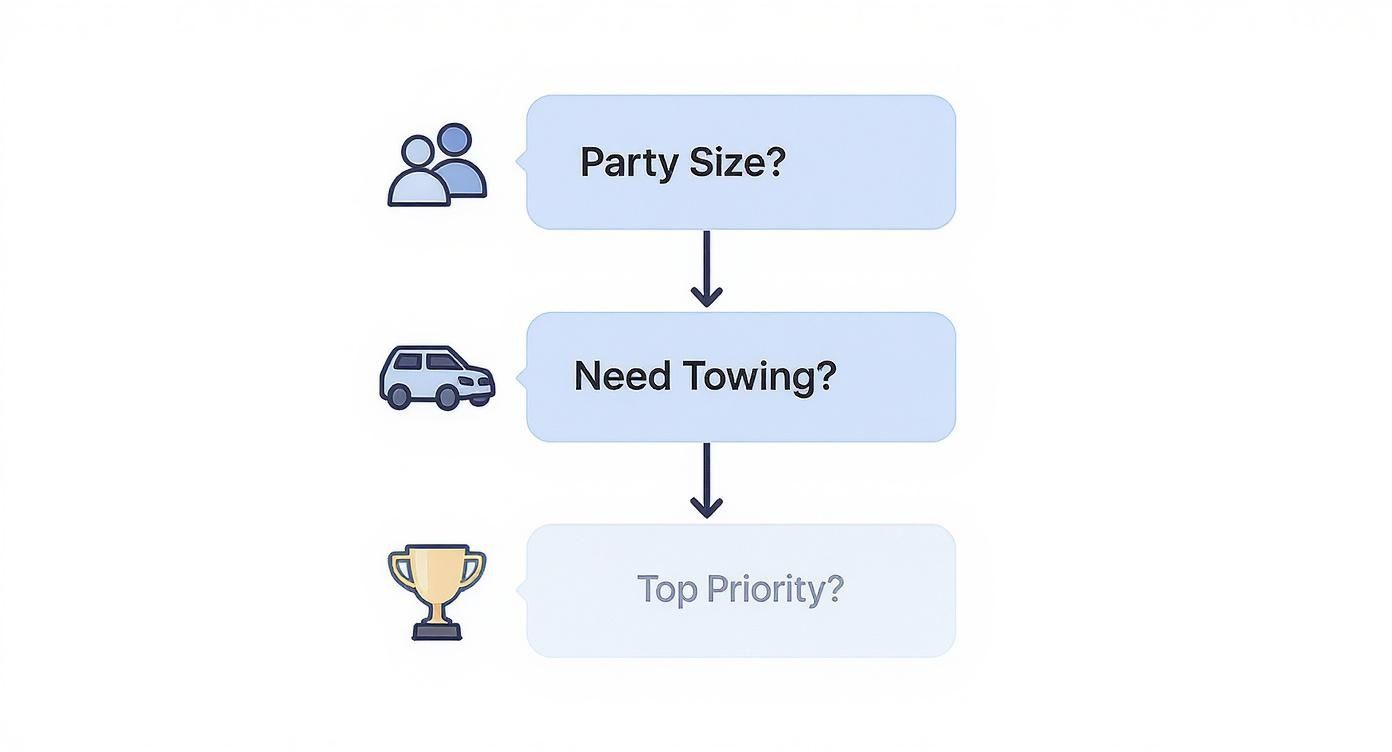
As you can see, figuring out if you prioritize passenger space, towing power, or fuel efficiency is the first step. Let's dig a little deeper into what makes each of these vehicle types tick.
The All-Terrain Adventurer: The SUV
There's a reason SUVs have become the go-to for so many families: they are incredibly versatile. If your trip involves anything beyond smooth pavement—like snowy mountain passes, gravel roads to a remote cabin, or just unpredictable weather—an SUV with all-wheel drive (AWD) or four-wheel drive (4WD) offers invaluable peace of mind.
This makes them the clear winner for families planning destination-focused adventures like camping, skiing, or hiking. Plus, if you need to bring a small camper or a trailer full of toys, many mid-size and large SUVs offer serious towing capacity. Models like the Chevrolet Tahoe are legendary for their ability to haul just about anything you can throw at them.
The trade-off for all that rugged capability is often interior space. While a three-row SUV has plenty of seats, the actual cargo room behind that last row can be surprisingly tight. You’ll need to pack smart or plan on using a rooftop cargo carrier.
The Unbeatable People-Mover: The Minivan
If your road trip priorities are all about maximum comfort and convenience, the minivan is in a league of its own. Nothing beats the simple genius of power-sliding doors in a crowded parking lot, especially when you're trying to wrestle a toddler into a car seat. The low, flat floor also makes it a breeze for everyone, from little kids to grandparents, to get in and out.
Inside, minivans are masters of space management. They almost always have more usable cargo room behind the third row than an SUV of a similar size. The seating is also incredibly flexible—many models have seats that slide, fold, or can be removed entirely, turning the interior into a massive, open cavern for all your gear.
A minivan's design is a direct answer to the real-world chaos of family life. Things like built-in vacuums, rear-seat entertainment screens, and an almost comical number of cupholders aren't just features; they're road-trip sanity savers.
Of course, minivans aren't built for off-roading. They are designed for the pavement, making them less ideal for rugged adventures. For many families, though, that’s a compromise worth making for the incredible comfort and space they deliver on long highway drives.
The Forward-Thinking Traveler: The EV
Electric vehicles are quickly becoming a fantastic option for family road trips, and it’s easy to see why. The whisper-quiet ride creates a peaceful cabin, and the "fuel" costs are significantly lower. Plus, the instant torque delivers smooth, effortless acceleration, even when you're fully loaded with people and luggage.
Family-focused EVs like the Kia EV9 and Hyundai IONIQ 5 often have really clever interior designs thanks to their flat floors and flexible layouts. This makes them feel surprisingly open and airy inside. The advanced tech and big infotainment screens are also usually a huge hit with everyone.
The main thing to consider, of course, is charging. An EV road trip requires a little more planning. You'll need to map your route to include DC fast-charging stations and factor in the time it takes to charge—usually 20-40 minutes to get back to 80%. While that might sound like a pain, many families find it creates a natural rhythm for meal stops and stretch breaks.
For a side-by-side breakdown, this table compares the key features across all three vehicle types.
Detailed Feature Comparison SUVs vs Minivans vs EVs
Feature | SUVs (e.g., Palisade, Tahoe) | Minivans (e.g., Odyssey, Sienna) | Electric Vehicles (e.g., EV9, IONIQ 5) |
|---|---|---|---|
Best For | Adventure, all-weather travel, towing | Maximum passenger comfort, easy access, cargo space | Tech-savvy families, quiet rides, lower fuel costs |
Passenger Space | Good (7-8 seats), but 3rd row can be tight | Excellent (7-8 seats), with easy access and ample room | Very good (5-7 seats), often with spacious, open-feeling cabins |
Cargo Capacity | Moderate; often requires rooftop box when 3rd row is up | Excellent; most usable space behind the 3rd row | Good; often includes a "frunk" for extra storage |
Drivetrain | FWD, AWD, or 4WD widely available | FWD standard; some models offer AWD | RWD or AWD; excellent traction from instant torque |
Key Features | High ground clearance, towing packages, rugged build | Sliding doors, flexible seating, family-friendly amenities | Quiet operation, advanced tech, one-pedal driving |
Primary Trade-Off | Lower fuel economy, less cargo space with 3rd row in use | Limited all-terrain capability, less stylish image | Requires planning for charging stops on long routes |
Ultimately, the best vehicle is the one that fits your family's road trip style. For a more detailed look at the specifications available for rent, you can explore the various car types Cars4Go offers.
Taking an EV on Your Family Road Trip
Thinking about taking an electric vehicle on your next family road trip? It's no longer a niche idea—it’s a fantastic one. Thanks to some serious advancements in recent years, range anxiety is becoming a thing of the past. What you get instead is a quiet, smooth, and tech-filled ride that can make your whole adventure feel a lot less draining.
The first thing you’ll notice is the space. Since there’s no engine or transmission tunnel hogging the floor, many EVs have a completely flat cabin floor. This simple design change is a game-changer for families, creating way more legroom and opening up clever new spots for stashing snacks, tablets, and all the little things that pile up on a trip.
Understanding the EV Road Trip Experience
The biggest mental shift with an EV trip is planning around charging stops instead of gas stations. Honestly, it sounds more complicated than it is. The trick is to line up your charging breaks with things you’d be doing anyway—like grabbing lunch, taking a bathroom break, or letting the kids burn off some energy at a playground.
Most road-trip-ready EVs can get back to 80% charge in about 20-40 minutes at a DC fast-charging station. That’s just about the perfect amount of time for a quick meal.
The goal isn't just to recharge the car; it's to recharge the family. A planned 30-minute stop every few hours can prevent driver fatigue and keep kids from getting restless, making the entire journey more enjoyable for everyone.
Of course, it pays to be prepared. Knowing about potential hiccups, like common EV charger issues, can save you a headache. This is where apps like PlugShare or A Better Routeplanner become your best friend. They don't just show you where chargers are; they give you real-time updates on whether they're working and available, so you can avoid pulling up to a broken station.
Top EV Models for Family Adventures
The market is now full of fantastic EVs built specifically with families in mind. These aren’t just tiny city cars anymore. They combine serious range with the space and features you need for a long haul.
Today’s electric SUVs are a great example. You've got workhorses like the Kia EV9, which offers up to 300 miles of range and can tow 5,000 pounds. Then there’s the Hyundai IONIQ 5, pushing nearly 325 miles of range with a super-flexible interior—its center console slides back and the front seats fully recline, perfect for a power nap. If you want a bit more luxury, the Genesis GV60 comes with features like massage seats and delivers around 310 miles of range.
Practical Tips for Your First Electric Journey
Ready to hit the road? A little planning goes a long way in making your first EV trip a total success. Always map out your charging stops ahead of time, and it’s smart to have a backup charger in mind for each stop, just in case your first choice is busy.
Here are a few more tips from the road:
Charge to 80%: At fast chargers, the charging speed drops off a cliff after the battery hits 80%. It's almost always faster to make more frequent, shorter stops to 80% than to wait around for that last 20%.
Use Hotel Chargers: Look for hotels that offer Level 2 charging for guests. Waking up to a fully charged car every morning is a huge convenience and saves you time on the road.
Pack Accordingly: Don't forget the "frunk"! That front trunk is the perfect place to store luggage you won't need until you arrive, keeping the main cargo area free for daily essentials.
With just a little bit of prep, you’ll find that road-tripping in an EV can be one of the most comfortable and relaxing ways to travel with your family.
How to Rent the Right Car for Your Trip
Let's be honest—sometimes your daily driver just isn't cut out for a massive family road trip. That’s where renting comes in. It’s a fantastic way to get the exact space, features, and gas mileage you need for one specific adventure, without the long-term cost. But the rental world can be a minefield of hidden fees and confusing rules.
A little planning before you book can save you a world of headaches later. Getting it right from the start means you can actually enjoy the drive instead of stressing about surprise charges when you drop the car off. Here’s how to sidestep the common traps and lock in the perfect vehicle for your family.
Mastering the Rental Process
The secret to a good rental experience is looking beyond the flashy daily rate. You need to think about the total cost and what your family actually needs on the road. A few key details can make a huge difference to your budget and your sanity.
First up, who’s driving? Most rental companies hit you with a steep daily fee for every extra driver.
On a long haul, sharing the driving isn't just a nice-to-have; it's a safety essential to avoid fatigue. Keep an eye out for deals that include a second driver for free. It’s a simple perk that can easily save you over $100 on a week-long rental.
Next, you absolutely have to check the mileage policy. Most rentals come with unlimited miles, but some sneak in restrictions, especially on bigger or more specialized vehicles. Going over the cap can result in painful per-mile fees that add up fast. For any real road trip, unlimited mileage is non-negotiable.
And if you have young kids, sort out the car seat situation ahead of time. You can rent them, but the fees are often ridiculous, and you never know what kind of quality you’ll get. Bringing your own is almost always the smarter, safer, and cheaper move. Most airlines will even let you check them for free.
Choosing Your Ride and Sealing the Deal
Once you have the policies figured out, it's time for the fun part: picking the car. Be real with yourself about how much space you need. A "Standard SUV" might sound big, but for a family of five with a week's worth of luggage, a "Full-Size" or "Premium SUV" is probably what you actually need. That little bit of extra cash for more room is often the best money you'll spend.
Before you even think about pulling out of the rental lot, give the car a good once-over.
Spot the damage: Do a slow walk-around and take a quick video or a few photos of any scratches, dings, or dents. Make sure the agent notes every single one on your rental agreement.
Test the basics: Flick on the lights, run the wipers, and blast the A/C. You don't want to discover a problem an hour into your drive.
Confirm the features: Count the USB ports. Seriously. Make sure the car has what you were promised and what you'll need to keep everyone happy and charged up.
Finally, know your insurance options. Your personal car insurance or even your credit card might already cover you, so do a quick check before you pay for the expensive plans they push at the counter. When you’re ready to book, finding a good provider makes all the difference. To cut through the noise, you can check out the latest Cars4Go rental deals for clear pricing and family-friendly options.
Smart Packing and Seating Strategies
You’ve picked out the perfect car for your family road trip. Now comes the real challenge: getting everyone and everything to fit comfortably inside. Let's be honest, smart packing is less about what you bring and more about creating a calm, organized space that keeps the journey just as fun as the destination. A little planning can be the difference between a smooth ride and total chaos.
First things first, rethink your luggage. Those rigid, hard-shell suitcases are a space killer, leaving all sorts of awkward, unusable gaps in the trunk. I always recommend using soft-sided duffel bags or even backpacks. They're pliable, which means you can squish them into every nook and cranny to make the most of your cargo space.
The best way to think about it is like a game of Tetris. Soft bags are your secret weapon, filling in all the gaps. I also swear by packing cubes to keep similar items together—it means you can grab one thing without having to pull the entire car apart at a rest stop.
This approach is the key to avoiding that dreaded "trunk explosion" every time you need to find something.
Maximizing Cabin Space and Comfort
Once the trunk is handled, it's time to focus on the cabin. The secret to a peaceful trip is having everything you need within easy reach, but not cluttering up the seats and floor. This is where a few smart organization hacks come into play. Over-the-seat organizers are a lifesaver, giving kids their own pockets for tablets, headphones, water bottles, and activity books.
Here are a few more tips I’ve learned over the years:
Create Snack Zones: Use small plastic containers or bento boxes for snacks. This simple trick contains the crumbs and spills, saving you from a massive cleanup job later.
Establish a Trash System: A small, dedicated car trash can is a game-changer. It’s a tiny addition that makes a huge difference in keeping the car tidy.
Use Vertical Space: If your car has roof rails, a rooftop cargo box is your best friend. It’s the perfect place for bulky, lightweight items like sleeping bags, pillows, or beach gear, freeing up valuable interior space.
Strategic Seating for a Peaceful Ride
How you arrange your passengers is just as important as how you pack your bags. If you’re in a three-row vehicle, try the "buffer zone" strategy. By placing kids in the window seats with an empty middle seat (or a cooler!) between them, you can dramatically cut down on sibling arguments. Trust me on this one.
This setup also makes it easier for you to hand back snacks or toys from the front. For even more great space-saving ideas, check out guides on must-have car camping essentials. At the end of the day, a thoughtfully organized vehicle is the foundation for a memorable, stress-free adventure. And for more travel inspiration, feel free to browse the guides over on the Cars4Go blog.
Common Road Trip Vehicle Questions
Even after you've weighed all the options, a few common questions always seem to pop up. Making that final call on the best car for your family road trip means matching your specific needs to what each type of vehicle does best. Let's tackle some of the most frequent dilemmas head-on.
Is an SUV or a Minivan Better for a Family of Five?
I'll be honest: for a family of five, the minivan usually wins on pure, unadulterated practicality. Those sliding doors are a lifesaver in tight parking lots, and the entire interior is built around maximizing passenger room and seating flexibility. You’ll almost always get more truly usable cargo space behind that third row.
But, a three-row SUV quickly becomes the smarter choice if your plans include rough weather, dirt roads, or towing a small trailer. It really boils down to this: do you want maximum interior convenience (minivan) or all-terrain, all-weather capability (SUV)?
Think about where you're going. A long highway haul across the country just screams minivan comfort. But a trip to a mountain cabin in the snow? That’s SUV territory. Your destination often makes the choice for you.
How Much Cargo Space Do I Really Need?
For a typical week-long trip, a good starting point is at least 15-20 cubic feet of cargo space behind the third row. That should give you enough room for a few suitcases and the essentials without having to pile things up and block your rear view.
If you’re planning a longer adventure or bringing bulky gear like a stroller or camping equipment, you’ll be much happier with a vehicle offering 30 cubic feet or more. And don't forget, a rooftop cargo carrier is a fantastic way to free up cabin space by moving lighter, bulky items overhead.
Are Electric Cars Reliable for Long Distance Road Trips with Kids?
Absolutely, as long as you do a little prep work. Modern EVs are more than capable of handling a road trip. The key is to pick a model with a real-world range of over 250 miles to give yourself a nice cushion between charging stops.
Planning your route with an app like A Better Routeplanner or PlugShare is a must. These tools map out DC fast-charging stations along your way. You can even time your charging stops to coincide with meals or a playground break, which is a perfect way to let everyone stretch their legs. Plus, the quiet ride and smooth acceleration in most EVs can make the journey surprisingly relaxing for the whole family.
Ready to find the perfect ride for your next family adventure? At Cars4Go Rent A Car, we offer a wide range of SUVs and minivans with family-friendly perks like complimentary car seats, a second driver, and unlimited miles. Find your ideal vehicle and book today at https://www.cars4go.com.
Comments