


Florida Car Rental Your Guide To The Sunshine State
- fantasma70
- Feb 12
- 13 min read
Having a rental car in Florida is your ticket to freedom. It's what lets you zip from the theme parks in Orlando to the electric nightlife of Miami without missing a beat. But the best way to do it means booking ahead, knowing the real cost beyond the daily rate, and picking an option that lets you skip the infamous airport rental lines and surprise fees.
How to Rent a Car in Florida the Smart Way

Renting a car here might seem simple, but a few key choices can make or break your trip. It's not just about what car you get; it’s about making your travel experience easy, affordable, and transparent. Thanks to Florida’s massive tourism scene, the rental market is fiercely competitive, which is great news for you—more options than ever.
It’s no wonder the industry is booming. Florida's car rental market is a giant, ranking #2 in the state for revenue and pumping a staggering 12.1% into the state's GDP. That growth is fueled by millions of visitors like you who need a set of wheels to see everything. It's a huge piece of the nearly $80 billion U.S. car rental industry.
Airport Rentals vs. Door-to-Door Delivery
The first big choice you'll make is where to get your car. The traditional way is to trudge over to the rental counter at the airport. But today, there's a much smarter alternative: having the car brought right to you.
Picture the typical airport rental counter. It’s like the longest checkout line at the grocery store right before a hurricane. You’re tired from your flight, and now you’re stuck waiting, dealing with confusing paperwork, and dodging aggressive upsells. Door-to-door delivery, on the other hand, is like having your groceries brought to your front door. No lines, no hassle, just convenience.
The real difference comes down to convenience and cost. Airport locations have to pay hefty fees to operate there, and guess who ends up paying for it? You do, through "concession recovery fees" and other surcharges tacked onto your bill.
An off-site or delivery service doesn't have those same overheads, which usually means a better price and a much smoother start to your vacation. Choosing an off-airport option gives you way more flexibility, and you can see what's available by checking out our car rental locations.
To see how these two options really stack up, let's put them side-by-side.
Airport Rental vs. Door-to-Door Delivery: A Quick Comparison
This table gives you a clear look at what to expect when renting at the airport versus using a convenient delivery service like Cars4Go.
Feature | Traditional Airport Rental | Cars4Go Door-to-Door Delivery |
|---|---|---|
Convenience | Long lines and shuttle buses are common after a long flight. | Your car is delivered directly to your airport terminal, hotel, or residence. |
Wait Time | Often 30-60 minutes or more during peak travel seasons. | Minimal wait time; the process is fast and personalized. |
Hidden Fees | Prone to airport surcharges, concession fees, and other taxes. | Transparent pricing with no hidden airport-related fees. |
Vehicle Access | You have to locate your car in a massive, confusing parking garage. | A representative meets you with the car, ready to go. |
Overall Experience | Can be a stressful and frustrating start to your vacation. | Provides a seamless, relaxed, and efficient beginning to your trip. |
As you can see, choosing delivery doesn't just save you from a headache—it can save you time and money, letting you get straight to enjoying your Florida trip.
Decoding the True Cost of Your Rental Car

That eye-catching daily rate you see online for a Florida rental car? It's often just the beginning of the story. Think of it as the base price for a concert ticket—it gets you in the door, but it doesn't cover the slew of service fees, facility charges, and taxes that pop up on the final bill. The real cost is usually tucked away in the fine print, and figuring it out beforehand is the only way to avoid sticker shock at the counter.
It’s not uncommon for travelers to see their final invoice jump 20-40% higher than the initial quote. This happens because the advertised price rarely includes all the mandatory fees, especially when you’re renting from a major airport hub. This is where a rental company's transparency—or lack thereof—can make or break your budget.
Uncovering Common Hidden Fees
So, what fills the gap between the advertised price and what you actually pay? A whole host of surcharges. They might have official-sounding names, but they all serve the same purpose: to increase your total cost. Knowing what to look for is your best defense.
Here are the usual suspects you'll find on a Florida car rental bill:
Airport Concession Fees: When you rent directly from an airport location, the company has to give the airport a cut of its revenue. That fee, often 10% or more, gets passed straight to you.
Customer Facility Charge (CFC): This is a daily flat fee airports use to fund their rental car centers, shuttle buses, and other infrastructure.
Vehicle License Recovery Fee: This small daily charge helps the rental company recoup the massive costs of licensing, titling, and registering its fleet of cars.
State and Local Taxes: On top of regular sales tax, Florida has its own rental car surcharge. These taxes can also change depending on the county.
These little charges can add up fast, turning what looked like a great deal into a pricey mistake. To keep your budget intact, always hunt for the "all-in" price before you click "confirm."
Reading the Rental Agreement Like a Pro
That rental agreement isn't just a formality; it's the contract that spells out every single potential charge. Don't let the agent rush you. Take a minute to actually scan it for the important details, because it can save you a real headache later.
Look for an itemized breakdown of charges. It should clearly list the base rate followed by every tax and fee. If you see vague terms like "miscellaneous fees" or unexplained "surcharges," it’s time to ask questions.
A good rental company doesn’t play games with pricing. The price you see when you book online should be the price you pay at the counter, period. No last-minute surprises or high-pressure tactics to sell you things you don't need.
This commitment to straightforward pricing is what you should look for. You can see how we handle this by checking out our car rental deals and what's included.
Credit Cards Versus Debit Cards
Believe it or not, how you pay can change your total cost and the entire rental experience. Most companies have a strong preference for credit cards because it’s easy for them to place a security deposit hold. Using a debit card, on the other hand, often means jumping through extra hoops.
Some agencies might run a credit check, demand to see proof of a return flight, or place a much larger hold on your debit card—we're talking $500 or more. That hold can tie up a big chunk of your vacation cash and might not be released for days after you've returned the car. Always check the company's debit card policy before you book to make sure you won't get hit with an unwelcome surprise when you arrive. Finding a company with flexible payment options can remove a major point of stress from your trip.
Choosing The Right Vehicle For Your Florida Trip
The car you rent in Florida is more than just a way to get from A to B—it's part of the vacation itself. Cruising down the Overseas Highway to Key West in a convertible is a totally different vibe than packing a spacious SUV with beach toys for a family day in Clearwater. The secret to a smooth trip? Matching your car to your plans from the get-go.
Think about it like picking the right shoes for an outing. You wouldn't wear hiking boots to the beach or flip-flops on a rugged nature trail. In the same way, a zippy little compact is a dream for navigating Miami's crowded streets and squeezing into tight parking spots, but it’s a non-starter for a family of five heading to the theme parks with a trunk full of luggage.
Match Your Ride To Your Adventure
So, what’s the perfect Florida rental car? It really boils down to who you're with and what’s on your agenda. A solo traveler or a couple might be looking for something fun and stylish, while a family needs practicality and space, period. Before you hit that "book now" button, let’s run through a few common scenarios.
Here’s a quick guide to get you started:
For Couples and Solo Travelers: You can’t go wrong with a stylish convertible or a sporty coupe. These cars are made for scenic drives along the A1A, letting you soak up the sun with the top down. Plus, they’re generally much easier to park in hotspots like South Beach.
For Small Families (3-4 people): A mid-size or full-size sedan hits that sweet spot between comfort, trunk space, and decent gas mileage. You’ll have enough room for a couple of kids and their bags without feeling like you're driving a bus through city traffic.
For Large Families and Groups (5+ people): This is where SUVs and minivans really come into their own. They offer plenty of seating, massive cargo space for strollers and suitcases, and the higher ride height that many drivers love.
It’s no surprise that locals love bigger vehicles, too. Out of 1.4 million new vehicles sold in Florida recently, a huge number were UVs and SUVs. They now make up 39.70% of the state's 19.52 million registered vehicles. Their popularity makes them the default choice for families, and rental companies have responded by offering essentials like complimentary car seats. You can dig deeper into Florida's vehicle trends on edr.state.fl.us.
Why Unlimited Mileage Is A Must-Have
Don't let the map fool you—Florida is a big state. The drive from Miami to Orlando is a solid four hours, and going from Jacksonville all the way down to Key West can easily eat up an entire day. This is exactly why a rental with unlimited mileage isn't just a nice perk; it's essential if you plan on exploring beyond a single city.
Can you imagine constantly checking the odometer, worried that a day trip to the Everglades might tip you over your mileage limit? That’s the kind of stress nobody needs on vacation.
Choosing a rental with unlimited mileage turns your trip from a fixed itinerary into a genuine adventure. It’s the freedom to take that spontaneous detour to a hidden beach or check out a cool little town you just heard about, all without a single thought about extra fees racking up.
This feature is especially important for a Florida car rental, where the best sights are often spread far and wide. It makes sure your trip is all about discovery, not distance anxiety. Once you know the kind of adventure you're after, you can browse different vehicle types to find your perfect match.
Sorting Out Florida's Rental Insurance and Tolls
Let's be honest: insurance and tolls are the two things that can turn a great Florida car rental deal sour. They’re confusing, buried in fine print, and can sneak unexpected costs onto your bill. Nailing this part isn't just about saving a few bucks—it's about giving you the peace of mind to actually enjoy your trip.
Think of rental insurance as a safety net for your vacation. Tolls, on the other hand, are the express lane to getting around Florida, but you have to know how the game is played to avoid getting overcharged.
What's The Deal With Rental Insurance?
When you step up to the rental counter, you'll almost certainly be offered a few insurance options. The big one is the Loss Damage Waiver (LDW), which you might also hear called a Collision Damage Waiver (CDW). It’s not technically insurance, but a promise from the rental company that they won't come after you for money if the car gets damaged or stolen.
But here’s the million-dollar question: do you actually need it? Before you automatically say yes, take a minute to see what coverage you might already have.
Your Personal Car Insurance: If you have car insurance at home, it often covers you when you rent a car. It's a good idea to give your agent a quick call before you travel to confirm it applies in Florida and to find out what your deductible is.
Your Credit Card: Many credit cards come with rental car coverage as a perk. Usually, this is "secondary" coverage, meaning it only pays out after your personal insurance has been used. Dig into your card's benefits guide to understand the specifics, as some cards have exclusions.
A little bit of homework here can save you a lot. That daily LDW fee might not seem like much, but it can add a hefty sum to your final bill over a week-long trip.
The Truth About Florida's Toll Roads
Florida has a massive network of toll roads, and a lot of them are now completely cashless. You can't just pull over and toss coins in a basket anymore. Instead, cameras scan your license plate as you drive through. It’s super efficient, but it creates a real headache for renters.
Rental companies have their own systems for this. The typical setup involves them offering you a toll transponder or automatically enrolling you in a program where they bill you later. The catch? They usually add a daily "administrative fee" on top of the actual toll cost. These fees can run anywhere from $5 to over $15 a day—and they often charge you for every single day of your rental, even if you don't go near a toll road.
This is where rental costs can balloon without you even realizing it. That daily fee on a two-week rental could easily add more than $100 to your bill, even if you only used a toll road once.
A good rental company will be upfront about this. At Cars4Go, for example, we offer a simple toll program that skips the high administrative fees, giving you a much more predictable and budget-friendly way to navigate Florida’s highways.
Thinking about what kind of driving you'll be doing also helps you pick the right car, which in turn affects your potential toll usage.
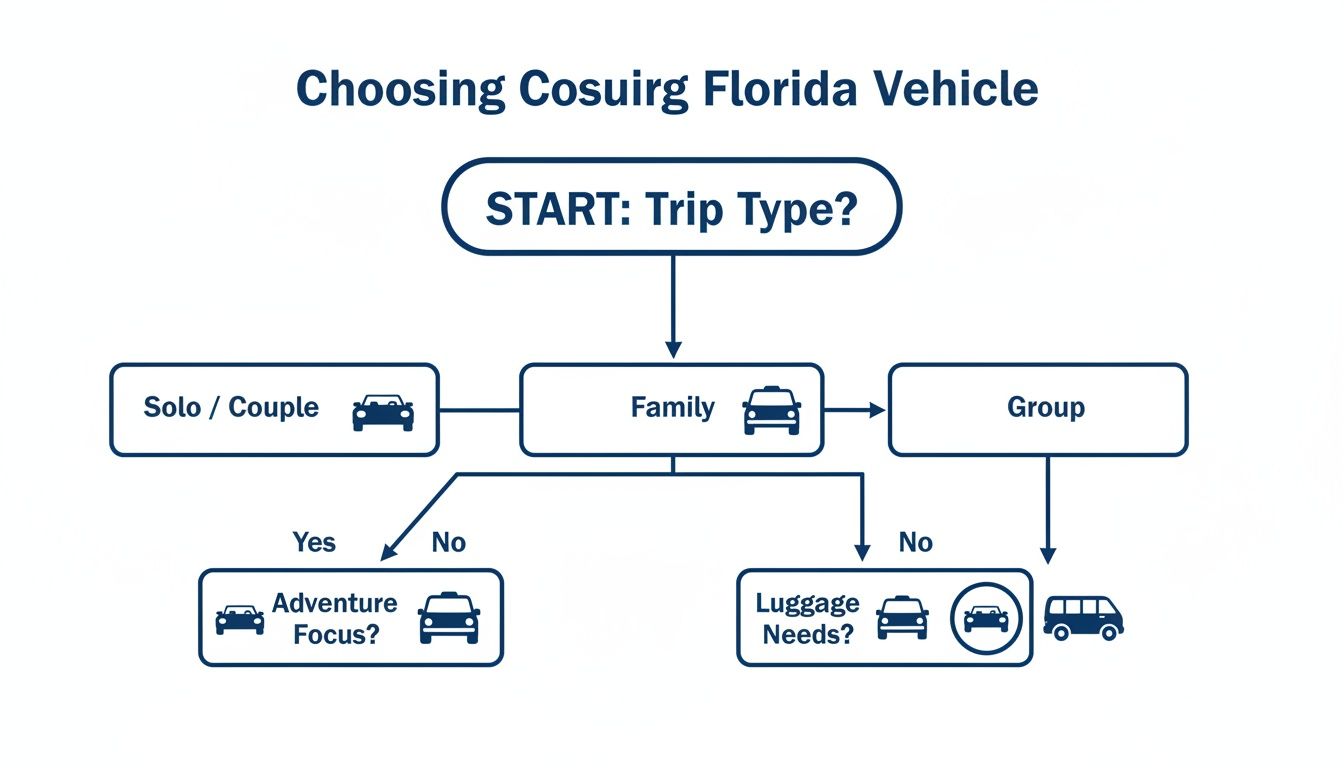
As you can see, figuring out if you're a solo traveler, a family on vacation, or a big group is the first step. A minivan packed with kids and beach gear is going to have a different driving pattern than a zippy convertible for two. When you get clear on your needs from the start, you can avoid paying for an oversized vehicle, unnecessary insurance, or a toll package that doesn't match your itinerary. It’s all about making your Florida rental experience smoother and more affordable.
Driving In Florida: Essential Tips For Visitors
Driving in Florida can be an absolute joy, with scenic coastal highways like the A1A just waiting for you. But it also comes with its own unique challenges, especially the bustling city traffic in Miami and Orlando. Getting a feel for the local driving rhythm is the key to a stress-free trip.
The roads here have a personality of their own. For instance, sudden, heavy downpours are a regular afternoon event, so be ready to slow down and give the car in front of you extra space. And remember, Florida law requires you to move over a lane for any stopped emergency or service vehicle—it’s a rule they take very seriously to keep first responders safe.
Navigating Urban Traffic And Major Highways
Let's be honest: the biggest headache you'll face is traffic in the major cities. Rush hour in Miami and Orlando, typically from 7-9 AM and 4-7 PM, can easily turn a quick trip into a crawl. If you can, plan your drives to avoid these peak hours.
The I-4 corridor connecting Tampa and Daytona Beach right through Orlando is notorious for its congestion. A good GPS isn't just a suggestion; it's your best tool for seeing slowdowns ahead and finding a quicker route. This is where having a reliable, well-kept rental car really pays off, giving you one less thing to worry about on a demanding highway.
It's a sobering fact, but Miami is often cited as one of the top U.S. cities for rental car accidents, largely due to its sheer volume of traffic and tourists. This really drives home the need to rent from a company that keeps its fleet in top-notch condition.
In this environment, a dependable car isn't a luxury—it's a critical piece of your travel safety.
Mastering Parking In Tourist Hotspots
Finding a parking spot in popular beach towns or tourist areas takes a little planning. In places like Fort Lauderdale or South Beach, prime spots near the sand disappear incredibly fast, particularly on weekends. Your best bet is often a public garage, which is usually just a short walk away and much more secure.
Most tourist areas now use mobile apps like PayByPhone or ParkMobile for metered parking. Do yourself a favor and download one before you even get here. It makes paying for your spot a breeze and lets you add more time from your phone without having to sprint back to the meter.
Of course, a simple mistake like a car lockout can derail your whole day. It happens to the best of us. Knowing there are local emergency lockout services available can get you back on your way without too much drama.
Finally, always, always read the parking signs. Tow-away zones are everywhere, and getting your rental towed is a costly, time-sucking nightmare you definitely want to skip. A little awareness of the local rules makes all the difference for a smooth ride.
Your Florida Car Rental Questions Answered
Renting a car in Florida for the first time? You probably have a few questions. Getting straight answers makes all the difference, so let's clear up the most common concerns before you book your trip.
What Documents Do I Need to Rent a Car in Florida?
Getting the keys to your rental is pretty straightforward. You'll need a valid driver's license from your home state or country, a major credit or debit card in your name, and proof that you’re at least 21 years old. Just be aware that most companies add a "young driver fee" if you're under 25.
If you're visiting from another country, it's always smart to have your passport with you as well. A pro tip is to find a rental company that happily accepts debit cards without freezing a huge security deposit on your account, which frees up your vacation funds.
Is It Cheaper to Rent at the Airport or Elsewhere?
Here’s a little secret: renting your car away from the airport is almost always cheaper. Airport locations get hit with extra concession fees and taxes, and guess who pays for those? You do. The convenience of grabbing a car right after you land is tempting, but it usually means higher prices and longer lines.
Think about it this way: an off-site service that delivers the car right to you offers the best of both worlds. You get the ultimate convenience without the bloated airport price tag, saving you time and money from the moment you arrive.
Can I Use My Own Car Insurance?
Most of the time, yes. Your personal auto insurance often covers rental cars, but you absolutely need to call your provider to confirm the details. Find out exactly what type of coverage extends to the rental and what your deductible is.
Don't forget to check your credit card benefits, too! Many cards include rental car insurance, though it usually acts as secondary coverage. A quick five-minute call to your insurance agent before you travel can save you from paying for expensive, redundant insurance at the rental counter.
How Do I Handle Tolls in a Florida Rental Car?
Florida is famous for its sunshine and its cashless toll roads. Most rental companies will offer you a toll transponder for a daily fee, but watch out—that fee is in addition to the actual tolls you rack up, and it can add up fast.
Always ask about the toll program's terms. If you already have a SunPass or E-ZPass, you might be able to bring it with you and use it in the rental. For a trip down to the Keys, this Key West Florida guide has some great driving tips. A good rental company will walk you through your options so you can pick the one that makes the most sense for your wallet.
At Cars4Go Rent A Car, we're all about making your Florida trip easy and enjoyable. With clear, honest pricing and convenient door-to-door delivery, we take care of the logistics so you can get straight to the fun. Book your perfect ride today at https://www.cars4go.com and see how simple renting a car can be.
Comments