


can you take a rental car to mexico: Rules & Insurance
- fantasma70
- Nov 15, 2025
- 13 min read
Absolutely, you can take a rental car to Mexico—but it definitely requires some homework. This isn't a spur-of-the-moment decision where you just point your car south and go. To do it legally and avoid major headaches, you need explicit permission from the rental company, the right kind of insurance, and the correct documents in hand. Nail these three things, and you're set for a fantastic trip.
Your Guide to Crossing the Border in a Rental Car
Think of this process as a mini-project. It might seem like a lot at first glance, but if you tackle it one piece at a time, it's completely manageable. I'll walk you through everything, from finding a rental agency that's cool with cross-border travel to making sure you have every last piece of paper you’ll need when you pull up to the border.
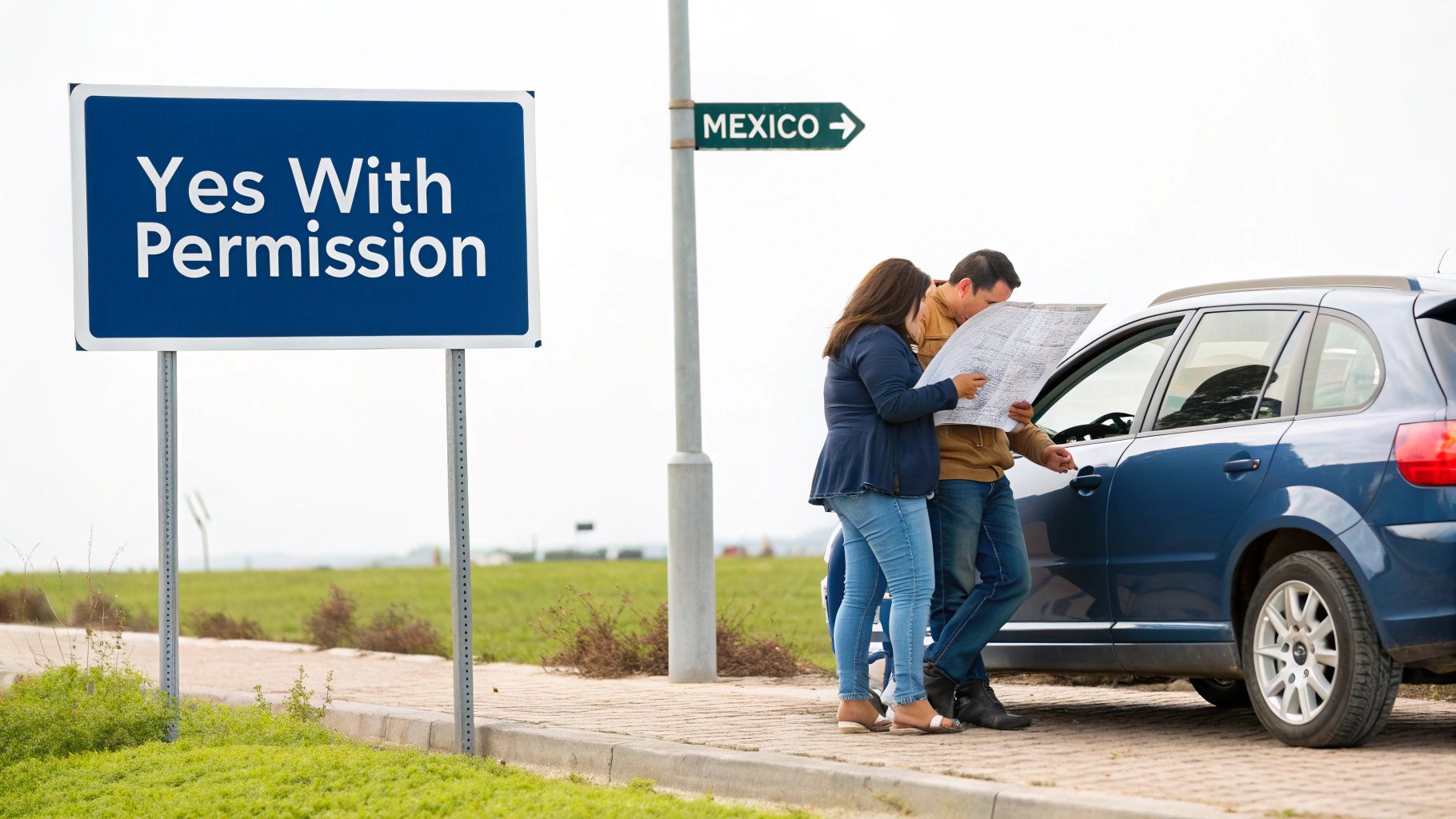
The system isn't meant to trip you up, but it does demand a bit of organization. Forgetting a single document could get you turned away at the border. Worse, if you get into an accident without the proper paperwork, you could face serious legal and financial trouble.
Key Requirements at a Glance
Getting this right comes down to three non-negotiable items. Each one serves a critical legal purpose and protects you, the rental company, and everyone else on the road.
Written Permission: Don't just take a verbal "okay." Your rental agreement must explicitly state you have authorization to drive the vehicle into Mexico.
Mexican Auto Insurance: Your US auto policy is not valid south of the border. You must buy a separate liability policy from a Mexican-underwritten insurance company.
Proper Documentation: You'll need your passport, driver's license, the rental contract, proof of that Mexican insurance, and possibly a Temporary Vehicle Importation Permit (TIP), depending on how far into Mexico you plan to travel.
A huge mistake people make is thinking their credit card's rental car insurance has them covered in Mexico. It absolutely does not. Mexican law is very clear: you must have a specific liability policy from an authorized Mexican insurer.
To give you a quick, scannable overview, here's a table summarizing exactly what you need.
Cross-Border Rental Checklist Quick View
Requirement | Why It's Non-Negotiable | Where to Secure It |
|---|---|---|
Rental Agency Permission | Driving into Mexico without it violates your contract and voids all insurance. | Directly from a rental company that allows cross-border travel (e.g., Hertz, Avis). |
Mexican Auto Insurance | Mexican law requires liability coverage from a Mexican insurer; US policies are invalid. | Through the rental agency or a third-party provider like Baja Bound. |
Valid Documents | You'll need to present these at the border and potentially at checkpoints within Mexico. | Keep your passport, license, rental contract, and insurance papers together and accessible. |
FMM Tourist Permit | Required for stays longer than 72 hours or travel beyond the border zone. | Obtain it at the INM office at the port of entry. |
Temp. Vehicle Import Permit (TIP) | Mandatory if driving outside the "Free Zone" along the border. | Apply online at the Banjercito website or get it at the border. |
Having these items sorted before you leave makes the border crossing process much smoother.
Getting these fundamentals right from the beginning will save you from a world of trouble later on. Once you have your ducks in a row, you can actually relax and look forward to the incredible food, culture, and scenery that await you in Mexico.
Finding a Rental Company That Allows Mexico Travel
So, you're ready for a road trip south of the border. The first, and most important, hurdle is finding a rental car company that will actually let you take their vehicle into Mexico. It’s not as simple as just booking a car online—you have to do a little homework first.
While big names like Hertz, Avis, and Enterprise often have cross-border policies, here’s the crucial detail most people miss: it’s not a company-wide rule. It all comes down to the specific branch where you pick up the car.

Think about it from their perspective. A rental office in San Diego or El Paso deals with Mexico travel every single day. An office in Seattle? Not so much. The local team makes the final call, so that's who you need to talk to.
Pick Up the Phone and Call the Local Branch
Forget the 1-800 number. The agents on the national hotline are great for general questions, but they almost never have the specifics on a local branch's cross-border rules. You'll likely get a vague or incorrect answer.
Your best move is to find the direct phone number for the actual location where you plan to rent. Give them a call and get right to the point.
Ask them two simple questions:
Do you allow your cars to be driven into Mexico?
If you do, are there any restrictions on what kind of car I can take or how far I can go?
This direct conversation clears up any confusion from the start and saves you from a massive headache on pickup day. You can find a list of rental locations to begin your search here: https://www.cars4go.com/car_rental_locations.php
Expert Tip: Getting a "yes" over the phone is great, but it’s not enough. When you’re at the counter picking up the car, you must insist that they note the permission to enter Mexico directly on your rental agreement. That piece of paper is your only real proof.
Know Your Geographic Limits
Even when you get the green light, don't assume you can drive all the way to Mexico City. Rental companies almost always have strict geographic restrictions in place for both insurance and logistical reasons.
Typically, you'll be limited to the "Free Zone" or "Border Zone." This area usually includes:
The entire Baja California Peninsula (Baja California and Baja California Sur).
A narrow strip of land along the U.S. border, usually about 15 to 20 miles into mainland states like Sonora.
For example, a trip from Tucson, Arizona, to Puerto Peñasco (Rocky Point) is a common and generally approved route. But trying to drive that same car deeper into Sonora, say to Hermosillo, would likely be a major breach of your contract.
Driving outside the approved zone is a serious mistake. If you have an accident, your insurance becomes void instantly, leaving you on the hook for all damages and liabilities.
The Final Step: Get It in Writing
You’ve done the research, made the calls, and confirmed the policy. Now for the final, non-negotiable step at the rental counter.
As you're signing the paperwork, double-check that the agent has added a note to your rental contract explicitly stating that travel into Mexico is authorized. It doesn't need to be fancy—something as simple as "Vehicle permitted for travel into Mexico" is perfect.
Without that line in writing, any verbal promises you received are worthless. That contract is your legal shield. If you’re stopped by the police or get into an accident, it’s the one document that proves you’re not violating the rental terms. It's the most important piece of paper you'll have for your cross-border drive.
Getting the Right Mexican Auto Insurance
This is probably the single most important thing you need to know: the moment you drive that rental car across the border, your U.S. auto insurance becomes completely worthless. I don't care if you have the best policy money can buy back home—under Mexican law, it means nothing.
You see, Mexico's legal system handles car accidents differently. If you're in a wreck, it's considered a criminal issue until you can prove you can pay for the damages. Without a valid, Mexico-underwritten insurance policy, you're looking at serious trouble. We're talking about having the car impounded or even being detained by the police.
Liability vs. Full Coverage: What You Actually Need
When you go to buy Mexican car insurance, you'll see two main options. It's crucial to understand what they cover so you can make the right call for your trip.
Third-Party Liability (TPL): This is the bare minimum you are legally required to have. It is not optional. TPL covers any damage you might cause to other people or their property. Driving without it is illegal, plain and simple.
Full Coverage (Collision/Theft): While not legally required, I can't recommend this enough. This add-on covers damage to the rental car itself, or if it gets stolen. Without it, you're on the hook for the entire value of the vehicle if something happens.
Honestly, for the peace of mind alone, just get the full coverage. The extra cost is a drop in the bucket compared to the nightmare of paying a rental company for a brand-new car out of your own pocket.
Key Takeaway: Mexican law is very clear—only insurance policies from companies licensed to operate in Mexico are valid. The proof of coverage from your U.S. insurer or credit card company won't cut it with the local authorities.
Where to Actually Buy Your Policy
You've got a couple of solid options here, and each has its pros and cons. The easiest route is usually buying the insurance directly from the rental car company. They'll often have a cross-border package that includes a compliant policy, which keeps all your paperwork in one neat little bundle.
Your other option is to go through a third-party provider that specializes in this stuff. Companies like Baja Bound or Sanborn's Mexico Insurance have been doing this for years and can sometimes offer better rates or more flexible plans. Just be sure to double-check with your rental agency that they accept the third-party policy.
No matter which path you choose, always, always keep a printed copy of your Mexican insurance policy in the car with you. If you get pulled over or have an accident, that piece of paper is your get-out-of-jail-free card.
This strict insurance requirement is part of Mexico's rapidly expanding transportation sector. As more commercial vehicles hit the road, the legal rules for all drivers become more defined. In fact, the Mexican Vehicle Leasing Association (AMAVe) is projecting a 10% growth in fleet leasing for 2025, largely due to the boom in logistics and delivery services. You can learn more about how the leasing market is evolving on GlobalFleet.com.
Getting Through the Border: Permits and Procedures
You’ve got your rental agreement and Mexican insurance locked down. Great. Now comes the final step: the border crossing itself. This isn't just about waiting in line; it’s about having the right paperwork for both you and the car. A little preparation here is the difference between a smooth start to your trip and a long, frustrating delay.
The two big documents you need to know about are the Forma Migratoria Múltiple (FMM) for people and the Temporary Vehicle Importation Permit (TIP) for the car. The FMM is your official tourist permit, and every single person in your vehicle, even the kids, will need one if you’re staying longer than 72 hours or venturing beyond the immediate border area.
First Up: The FMM Tourist Permit
Getting your FMM is pretty simple. When you cross, you'll be directed to the Instituto Nacional de Migración (INM) office. Pop inside, show your passport, fill out the form, and an agent will stamp it and write down how many days you’re approved to stay.
Here’s a pro-tip: keep that little piece of paper with your passport. You have to turn it in when you leave Mexico. If you lose it, you're looking at fines and a headache trying to get an exit stamp. Don't let that be you.
Does Your Car Need a Permit? Understanding the TIP
Now, let's talk about the car's paperwork. The Temporary Vehicle Importation Permit (TIP) is a big one, but here’s the good news—you might not even need it.
A TIP is only required if you plan to drive outside of the designated "Free Zone." This zone is pretty generous, covering the entire Baja California peninsula and a 15-20 mile strip along the border in mainland states like Sonora.
So, if you’re just heading to Tijuana, Ensenada, or Rocky Point for the weekend, you can skip the TIP. But if your adventure takes you deeper into mainland Mexico, getting a TIP is non-negotiable. Driving past the interior checkpoints without one is a serious offense and could get your rental car impounded.
To get a TIP, you'll visit a Banjercito office—that's the official Mexican army bank—which you’ll find right at the border crossing. Be prepared to pay a refundable deposit, which you’ll get back when you officially check the car out of the country on your way home.
Speaking of paperwork, your insurance policy is one of the most critical documents you'll carry. Make sure you handle it correctly.
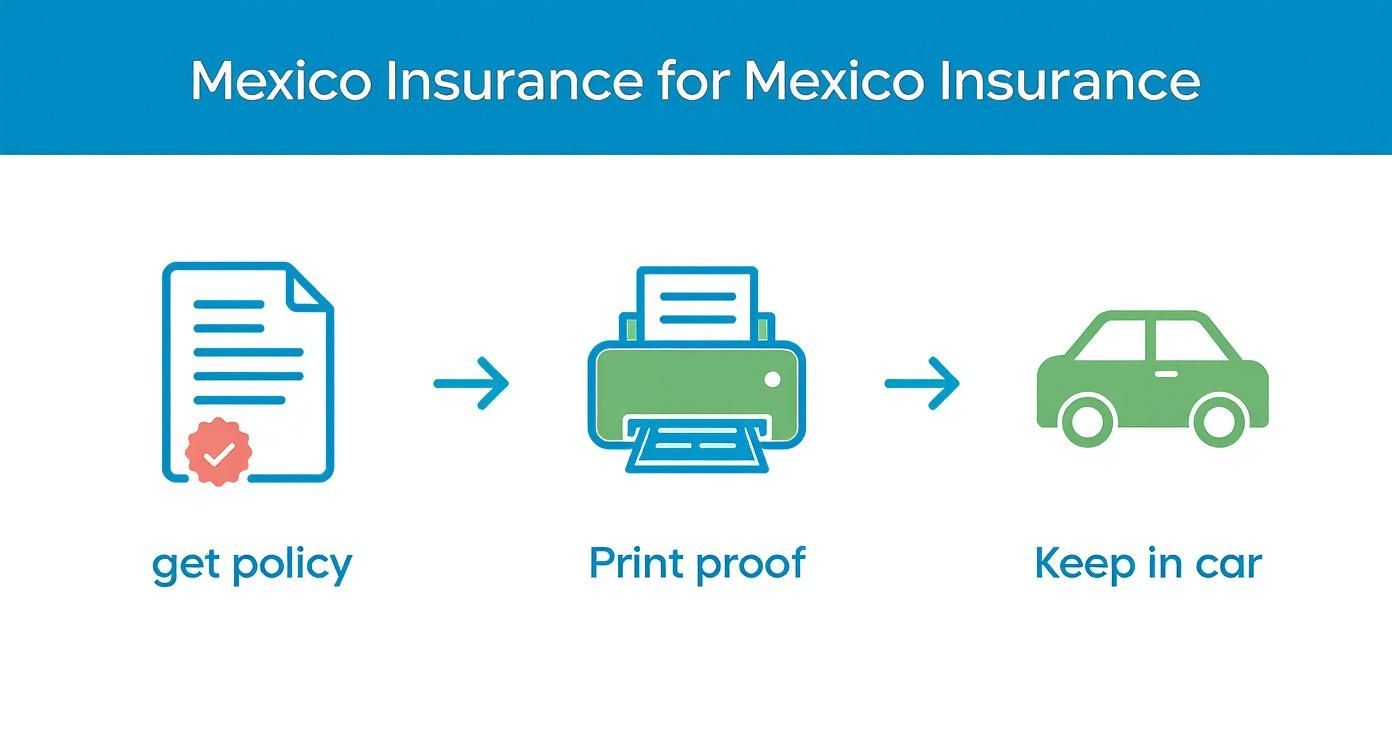
This simple process is key. Always have that printed copy in your glove box, ready to show any official who asks.
The whole process of flying in, renting a car, and crossing the border is getting easier, thanks in part to some massive infrastructure projects. For example, Grupo Aeroportuario del Pacífico (GAP) is in the middle of a USD 2.6 billion investment to modernize 12 airports by 2029. They’re aiming to increase capacity by 50%, which is great news for travelers. You can read more about Mexico's growing car rental market and how these upgrades are changing the game.
Your Border Crossing Document Checklist
Before you even get in line at the border, get a folder and put these documents inside. Keep it in the front seat with you, not buried in a suitcase in the trunk.
Valid Passports: One for every person in the car. No exceptions.
Valid Driver's Licenses: For anyone who plans on driving.
Original Rental Agreement: Make sure it clearly states you have permission for Mexico travel.
Printed Proof of Mexican Auto Insurance: Your phone screen won’t cut it. You need the physical copy.
Vehicle Registration and Title: The rental agency should have provided this for you.
Having all your ducks in a row like this shows you’re a prepared and respectful traveler. It makes things easier on the border officials and, most importantly, on you.
Driving Tips and Rules of the Road in Mexico
Alright, you've handled all the paperwork, crossed the border, and now the real adventure begins. Driving in Mexico is an experience, and while it might feel a little different from what you're used to, it's nothing you can't handle. The key is to stay alert and adopt a defensive mindset—the driving culture is just a bit more... fluid.
What the Road Signs Are Telling You
First things first, let's talk signs. Many of them are pretty universal, but a couple are absolutely crucial to know right off the bat. The octagonal red sign that says "ALTO" is your standard stop sign. No ambiguity there; treat it just like you would back home.
The other sign you'll learn to respect, and quickly, is the one that reads "TOPE." This is a warning for a speed bump, and let me tell you, Mexican topes are legendary. They can be massive, pop up with little warning, and often aren't painted. Hitting one of these too fast is a surefire way to damage your rental's suspension.
Getting a Feel for Local Driving Customs
Beyond the signs on the road, knowing a few local customs will make your drive so much easier.
For instance, when you pull into a gas station, don't get out to pump your own gas. Every station is full-service, and they're all run by the state-owned company, PEMEX. An attendant will come to your window; just tell them how much you need ("lleno" for a full tank) and they'll take care of everything. It's customary to tip them around 20-30 pesos for their service.
You'll also likely come across military or federal police checkpoints, especially on the main highways. Don't let this rattle you—it's completely normal.
Just slow down and be ready to stop if they flag you over. Keep your documents handy. The officers are usually professional and might just glance inside and wave you on. A calm, respectful attitude is all you need.
One fantastic resource to keep in mind is the "Ángeles Verdes" (Green Angels). This is a government-funded patrol that cruises the major highways specifically to help tourists with car trouble. If you get a flat tire or break down, these guys are a lifesaver, and their help is free.
Staying Safe on the Road
Here’s a piece of advice I give to everyone: avoid driving long distances at night. It's just not worth the risk. Many roads aren't well-lit, making it incredibly difficult to spot hazards like potholes, animals, or those infamous topes. Plan your long hauls between cities for the daytime. This one simple habit makes a world of difference.
Exploring Mexico by car is becoming more and more popular, and for good reason. The country's car rental market is booming—it was valued at USD 1,478.8 million in 2025 and is expected to hit USD 2,900.2 million by 2032. You can read more about the growth of Mexico's car rental market if you're curious. This trend just shows how many travelers are discovering the freedom of a road trip.
Finally, think about the car you're in. A small, zippy compact is perfect for navigating tight city streets, but if you plan on exploring more rural areas, you might be happier with an SUV. Take a look at our guide on the different car types available for rent to make sure you pick the right ride for your adventure.
Common Questions About Renting a Car for Mexico
Even after you've done all your homework, a few nagging questions can pop up. It's totally normal. Let's walk through some of the most common things people ask before they drive a rental car across the border.
What Happens if I Go Without Permission
Let's be blunt: taking a rental car into Mexico without the company's explicit, written permission is a terrible idea. The second your tires hit Mexican pavement, you've breached your contract.
That means every bit of insurance—the policy from the rental agency and even the mandatory Mexican insurance you bought—is instantly null and void.
If you get in a wreck, the car is stolen, or it just gets a dent, you are on the hook for the full value of the vehicle. Worse, you'll be paying for any damage to other people's property out of your own pocket. That can lead to a legal and financial nightmare in a foreign country.
The takeaway is simple: never, ever cross the border without that official letter of permission in your hand. The risk is just too high.
Can I Drive Anywhere in Mexico
Nope. Even the companies that allow their cars into Mexico have strict rules about how far you can go. This isn't just them being difficult; it's for very real insurance and safety reasons.
Most of the time, you'll be limited to what's called the "Free Zone." This typically includes:
The entire Baja California peninsula, from Tijuana down to Cabo.
A narrow border zone in mainland Mexico, usually just 15-20 miles south of the border in states like Sonora.
Driving beyond this approved zone is a serious violation of your rental agreement. If you're thinking about a longer journey deeper into the country, you'll want to explore other options. We cover some of those in other guides on the Cars4Go blog.
Is Renting in the US or Mexico Cheaper
This really comes down to your travel plans.
If you're just popping down to a border town like Tijuana for a weekend or visiting Rocky Point (Puerto Peñasco), renting in the U.S. is usually the most straightforward and convenient choice.
But if you’re planning a longer trip far from the border, it almost always makes more sense to fly into a major Mexican city and rent a car there. You'll skip all the hassle of border permits, geographic restrictions, and cross-border insurance.
What if the Police Pull Me Over
First, don't panic. Just stay calm, be respectful, and pull over safely. Have your documents ready to go: your driver's license, the rental contract with the permission letter, and your proof of Mexican auto insurance.
If the officer claims you committed a traffic violation, you have the right to request a formal, written ticket (an infracción). You can pay this later at a police station or other designated office.
Be very wary if an officer asks you to pay a fine in cash right there on the spot. This is not how it works and is likely an attempt to get a bribe, which is known as a mordida. Politely insist on a written ticket.
Ready to plan your next adventure? At Cars4Go Rent A Car, we offer transparent pricing and a seamless rental experience to get you on the road with confidence. Book your vehicle today at https://www.cars4go.com.
Comments